You spent years developing your skill. Years of study, clinical hours, postgraduate training, CPD. Years of honing a craft that is genuinely difficult, genuinely valuable, and genuinely admired by the people who benefit from it. And yet.
If you are honest with yourself, the skill has not produced the freedom you expected. The clinical excellence is real. The financial pressure is also real. The appointment book is full. The reserves are not. The craft is admired. The autonomy is not.
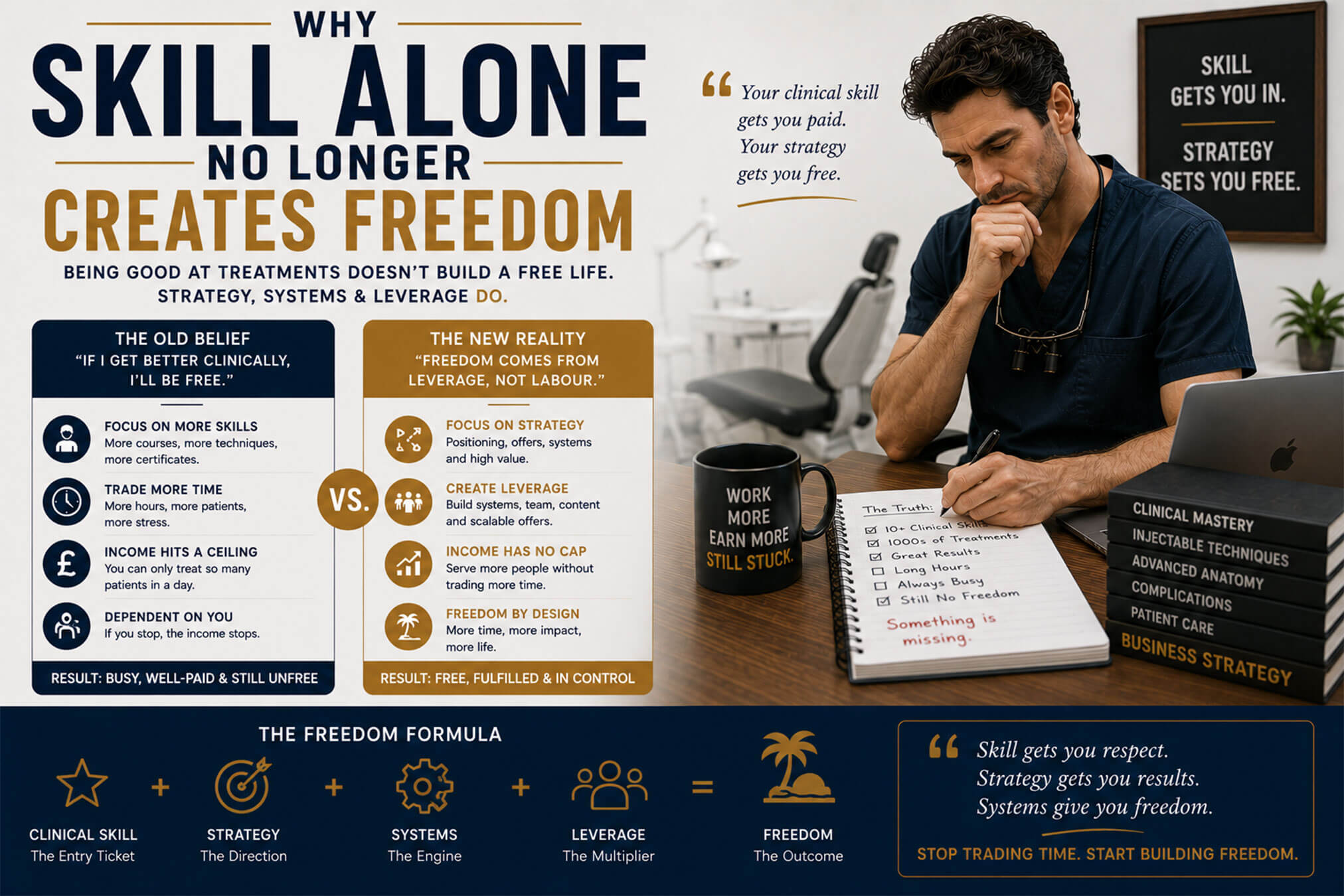
This is the central paradox of professional life in 2026 — and it demands a direct answer: skill alone no longer creates freedom. It never did, but the gap between believing it should and experiencing that it doesn’t has never been wider or more painful than it is right now.
The Skill‑Freedom Fallacy
The belief that mastery automatically translates into freedom is deeply embedded in professional culture. It is transmitted through training, modelled by mentors, and reinforced by every qualification certificate that gets framed and hung on a surgery wall. Work hard. Develop expertise. Excellence will be rewarded.
This narrative has a grain of truth — skill does attract patients, enables private income, and supports professional reputation. But it contains a fatal structural error. It conflates the quality of what you do with the architecture through which you do it. And that architecture — the NHS contract, the active income model, the UDA ceiling — does not reward skill differentially.
The most technically brilliant dentist in a practice earns, within the NHS framework, essentially the same as a competent, averagely ambitious one. Excellence is rewarded with a full appointment book. Not with proportionate income. Not with time. Not with freedom.
The research confirms what practitioners feel. UK dental professionals report high burnout and dissatisfaction not because they lack skill, but because their skill is deployed in a system that does not return freedom in proportion to expertise. More skill does not fix a structural ceiling. It just makes the ceiling more frustrating to hit.
What Skill Actually Gives You
This is not an argument against skill development. Clinical mastery remains foundational — to patient safety, to professional identity, to the confidence that underlies everything else.
But skill is an input, not an output. It is a tool, not a destination. And the mistake that keeps high‑performing clinicians trapped is treating the tool as though it were the prize
What skill actually gives you — when understood correctly — is access. Access to markets, to patients, to income models, and to opportunities that would not be available without the credibility your expertise provides. The dentist who trains in facial aesthetics is not buying freedom with a course fee. They are using their existing clinical skill as a key to unlock a market — the multi‑billion‑pound UK aesthetics sector — where the economics of time and expertise are fundamentally different from those of NHS dentistry.
The skill is the entry ticket. The architecture you build around that skill is the vehicle for freedom.
The Three Things That Create Freedom
If skill alone does not create freedom, what does?
Systems.
Systems are the structures that allow value to be delivered without requiring the original skill‑holder’s constant physical involvement. A well‑designed consultation process, a patient communication workflow, a treatment pricing architecture — these are systems that amplify the value of clinical skill without requiring proportionally more clinical hours. The Botulinum Toxin Club’s Singh’s Success System® is precisely this: a systematic commercial architecture designed to convert existing clinical expertise into optimised, repeating revenue without exhausting the practitioner who delivers it.
Leverage.
Leverage is the mechanism by which resources — capital, knowledge, relationships, time — are applied to produce returns that exceed the input. Financial leverage, as the Dental Property Club teaches, means deploying your creditworthiness and professional income into property assets that appreciate and generate yield independently of your clinical presence. Knowledge leverage means transforming what you already know — your anatomical expertise, your clinical frameworks, your patient communication skills — into educational, commercial, or aesthetic income that pays you for the expertise, not just the hour.
Energy.
Energy is the most undervalued and most frequently depleted resource in professional life. It is also, paradoxically, the one that most directly determines the quality of everything else. A dentist with strong systems and sound leverage who is operating on depleted reserves will underperform against their own potential — in clinical decision‑making, in business judgment, in the quality of relationships that underpin referral and reputation. Performance Reset exists precisely to address this: to restore the physiological and cognitive capacity that transforms good systems and sound leverage from theoretical tools into genuinely productive ones.
The Shift That Changes Everything
The dentist who continues to invest solely in clinical skill — who pursues more CPD, more postgraduate qualifications, more advanced techniques — without building systems, leverage, and energy management is essentially adding floors to a building with a compromised foundation. The floors are real and impressive. The building still cannot support the life that is trying to be lived at its summit.
The shift that changes everything is conceptually simple, even if its execution requires sustained commitment: from skill as identity to skill as foundation. From “I am a skilled dentist” as a terminal statement to “I am a skilled dentist, and I am building the architecture that allows that skill to generate freedom.”
This is not a diminishment of clinical vocation. It is the fullest possiblehonouring of it — the recognition that the years of effort invested inbecoming exceptional deserve a professional and financial life that is actuallyproportionate to that investment.
Skill got you here. The architecture is what takes you further.
Dr Harry Singh is the founder of the Botulinum Toxin Club (botulinumtoxinclub.co.uk), the Dental Property Club (dentalpropertyclub.co.uk), and Performance Reset (performancereset.co.uk).