The most common way dentists first think about facial aesthetics is financially
An extra income stream.
A way to supplement NHS earnings.
A hedge against pressure inside traditional dentistry.
A high-value treatment that can sit alongside existing work.
That framing is understandable. It is also incomplete.
Because facial aesthetics, when understood properly, is not just about adding revenue. It is about expanding professional identity, increasing leverage, creating better economics, and stepping into a more modern version of what a clinician can be.
Yes, the income matters.
But if that is the only way a dentist sees aesthetics, they are massively underestimating what it can do.
It Starts With a Misunderstanding
There is a persistent misconception that facial aesthetics sits outside dentistry.
As though it belongs to another world. Another profession. Another category of practitioner. As though dentists who enter it are somehow leaving their lane.
The opposite is closer to the truth.
Dentists are exceptionally well positioned for facial aesthetics. Their clinical training gives them a working relationship with facial anatomy that is both deep and practical. They understand proportions, symmetry, profile, musculature, balance, tissue handling, injection precision, and patient expectations around appearance better than many practitioners entering the space from less anatomically rigorous backgrounds.
They are already clinicians of the face.
Dentistry may have trained them to focus mostly on the oral component of that face, but the leap into facial aesthetics is not a leap away from core competence. It is often a natural extension of it
That matters because confidence grows much faster when a new opportunity is built on existing strength.
Extra Income Is the Smallest Benefit
The financial upside of aesthetics is real. It would be naive to pretend otherwise
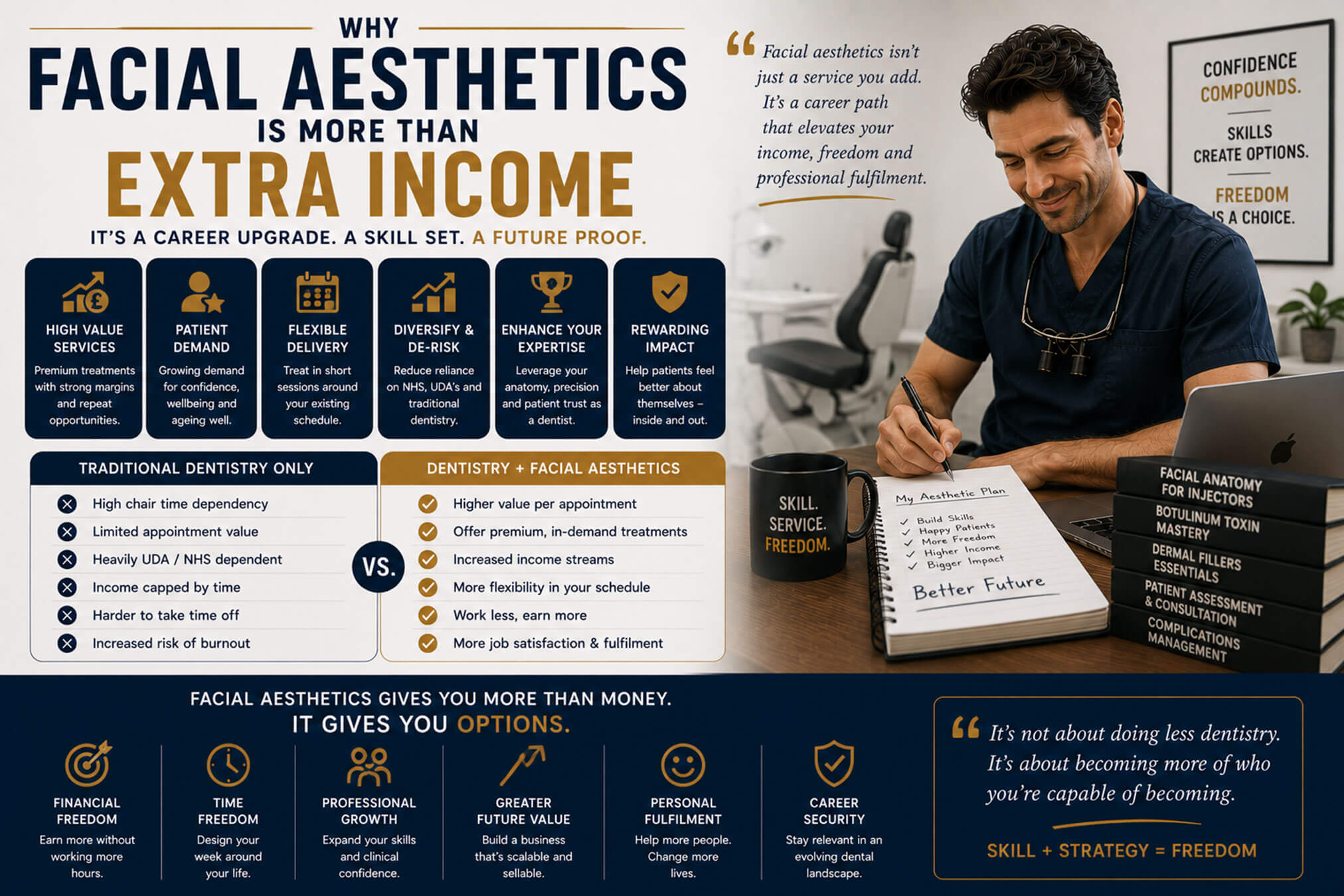
Compared with many traditional clinical models, facial aesthetics can offer stronger margins, more control over pricing, lower dependence on volume, and a more commercially efficient use of appointment time. For dentists used to the arithmetic of NHS work, this difference can feel almost shocking at first.
But even then, the money is only part of the story.
Because “extra income” still sounds like a side effect.
And for many dentists, aesthetics becomes far more than that. It becomes the first move in a broader professional shift — one where the clinician begins to see that their expertise can operate in markets with very different rules, different economics, and different emotional dynamics.
This is important.
When a clinician discovers that their skills can create value outside the system that has exhausted them, something psychological changes. They stop seeing themselves purely as participants in one model and start seeing themselves as people with options.
That shift is worth more than the first few injections ever are.
It Changes the Nature of the Patient Relationship
One reason facial aesthetics feels so different from traditional dentistry is that it changes the emotional tone of the work.
In dentistry, especially NHS dentistry, many patient interactions are shaped by need, urgency, fear, pain, repair, cost sensitivity, and limited time. Even when the clinician is excellent, the relationship can become compressed by the system around it.
Facial aesthetics often operates differently.
The consultation is more spacious. The patient is usually there by choice, not necessity. The conversation is less about fixing a problem and more about confidence, refinement, balance, and self-image. The treatment plan is often collaborative rather than reactive. The emotional experience is different for the patient and, crucially, for the practitioner.
This changes how the work feels.
For many dentists, aesthetics reawakens a part of clinical life that had gone quiet: creativity. Curiosity. Nuance. The feeling of being deeply present rather than mechanically productive. The sense that the practitioner is not simply clearing a list but guiding an outcome that the patient values in a more personal way.
That kind of work can be financially rewarding, yes.
But it can also be professionally renewing.
It Expands Clinical Identity
This is where facial aesthetics becomes much more interesting.
Most dentists have been conditioned to think of themselves inside a relatively narrow frame. Even successful dentists often identify first and foremost as providers of restorative, preventative, or cosmetic dental care. Their professional map is bounded by what dentistry has historically looked like.
Facial aesthetics expands that map.
It asks the practitioner to think not just about teeth, but about the face as a whole. Not just about occlusion and restorations, but about balance, ageing, proportion, and confidence. Not just about treatment, but about presence, visual harmony, and how patients experience themselves.
In doing so, it evolves the dentist from a technically skilled operator into a broader facial clinician.
That is not a small shift. It is a reframe of identity.
And identity matters because it shapes what people believe they are allowed to build.
A dentist who sees themselves narrowly will make narrow career decisions.
A dentist who sees themselves as a clinician with broader aesthetic authority begins to operate differently — commercially, professionally, and psychologically.
It Improves the Economics of Time
One of the most limiting features of conventional dentistry is not simply the work itself. It is the way the economics of the work are structured.
Too many clinicians are trapped in models where income depends on volume. More patients. More appointments. More procedures. More output. More exhaustion.
Facial aesthetics interrupts that model.
It creates the possibility of higher-value clinical activity delivered in a more focused, premium way. It allows the same hour to behave differently financially. It allows the same professional to generate more without automatically increasing physical output. It opens the door to a business model where margin matters more than sheer throughput.
This is a fundamental distinction.
Because once the economics of time improve, strategic options expand.
Surplus becomes possible.
Investment becomes possible.
Reduced dependency becomes possible.
Space becomes possible.
That is why aesthetics is not just additive revenue. It is often the first source of breathing room in a clinician’s entire financial architecture.
And once breathing room exists, better decisions can begin.
It Teaches Commercial Thinking
Another overlooked benefit of facial aesthetics is that it teaches dentists to think commercially in a way that much of their original training never did.
Aesthetics requires positioning. Messaging. Patient journey design. Pricing confidence. Consultation architecture. Repeat treatment systems. Trust-building. Brand clarity. Experience design.
These are not side issues. They are part of the work.
That means the clinician who enters aesthetics successfully is not just learning a new treatment. They are learning business. They are developing a more sophisticated understanding of how value is perceived, how demand is created, and how clinical expertise becomes commercially legible in the market.
This is one of the reasons the right training environment matters so much.
A poor aesthetics course teaches technique only.
A strong one teaches transformation — clinically, commercially, and strategically.
Because the real opportunity is not learning how to inject. It is learning how to build.
It Can Become the First Door to Freedom
For many dentists, facial aesthetics is the first concrete proof that their future does not have to look like their past.
It is often the first place where they see their skills produce different results in a different system. The first place where time begins to behave differently financially. The first place where they feel more energised by patient work rather than more drained by it. The first place where they realise they are not trapped by their original model — only by their loyalty to it.
That is why aesthetics should never be dismissed as “just a side income.”
Done properly, it is not a side line. It is a gateway.
A gateway to better economics.
Better positioning.
Better energy.
Better confidence.
Better strategic optionality.
And often, it becomes the first serious step toward a much broader kind of professional freedom.
The Better Question
The wrong question is:
Can facial aesthetics make me extra money?
Of course it can.
The better question is:
What kind of clinician — and what kind of life — does facial aesthetics make possible?
That is the more strategic question.
The more interesting question.
And for many dentists, the more life-changing one.
Because the real value of aesthetics is not that it adds income.
It is that it expands what a dentist can become.
Dr Harry Singh is the founder of the Botulinum Toxin Club (botulinumtoxinclub.co.uk), the Dental Property Club (dentalpropertyclub.co.uk), and Performance Reset (performancereset.co.uk).
References
- Flow state and peak performance - Zevo Health - This article explores flow state and how it has such a positive impact on performance and wellbeing ...
- The Psychology of High Performers: Understanding the Elite Mindset - They don't just believe in their ability to improve; they actively seek out challenges that push the...
- Development and validation of a flow state scale for healthcare ... - The flow state is referred to by various terms—such as optimal performance, peak experience, and wor...
- If I stop, who am I? Identity shifts for high performers who are tired of ... - Identity shifts can feel tender at first, especially for high performers who are used to being stron...
- Dentistry is Shifting From Functional To Aesthetic and Wellbeing - Another reason dentists are adding beauty treatments is the financial opportunity. Cosmetic treatmen...
- Multiple Streams of Income for Doctors - The White Coat Investor - Just as diversification in your portfolio is valuable, so is receiving income from uncorrelated, mul...
- Property investment – the ideal passive income stream in 2021 - One of the great realisations for dentists in 2020 was that their income is not as rock solid as the...
- Is passive income possible for dentists? | Dr. Ingrid Murra - LinkedIn - Is passive income possible for dentists? The answer is yes. Here's how to build revenue streams that...
- How stress and burnout impact dental teams - General Dental Council - Workplace difficulties deeply affect our overall mental health, making it crucial for dental teams t...
- NHS England » Submission to the Review Body on Doctors' and ... - Overall, the NHS is providing more care contacts in 2024 across secondary care services, mental heal...