
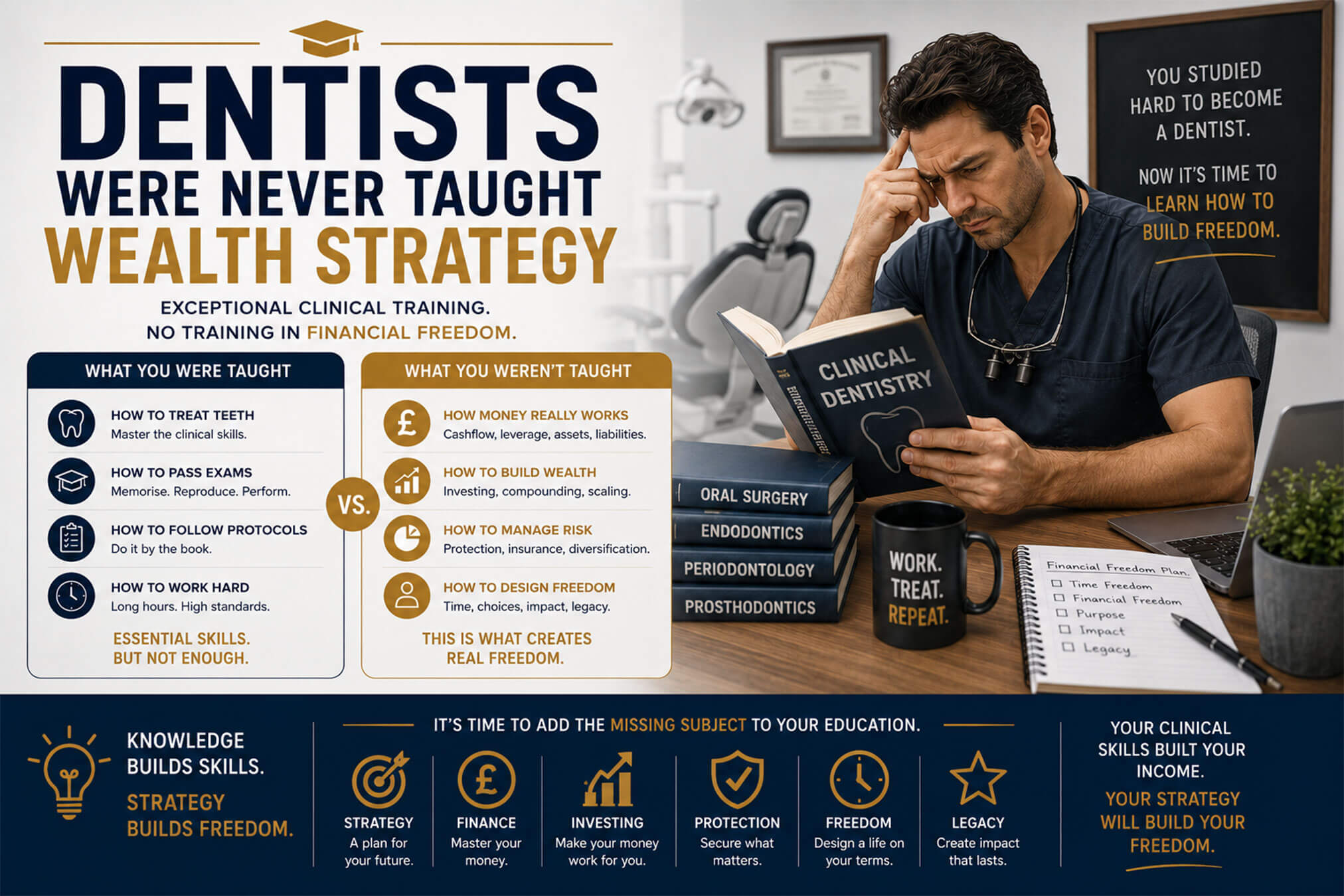
Think about the breadth of what dental school trained you for.
Oral anatomy. Pharmacology. Radiography. Periodontics. Restorative technique. Oral surgery. Paediatric dentistry. Medical emergencies. Infection control. GDC standards. Ethics. Record keeping. Patient communication.
Years of clinical education. Thousands of hours of study, practice, and assessment. A level of technical preparation that few professions can match.
And yet somewhere inside all of that, something essential was missing.
Not one serious module on wealth creation.
Not one framework for building passive income.
Not one clear explanation of how to convert professional earnings into financial independence.
Not one real education in leverage, investing, tax strategy, or long-term financial design.
Dentists were trained to generate income.
They were not trained to build wealth.
And that distinction explains more of the professional stress inside dentistry than most people realise.
The Invisible Curriculum Gap
Most dentists graduate with a clinical operating system, not a financial one.
They know how to diagnose. They know how to plan treatment. They know how to manage risk, communicate with patients, and execute precise procedures under pressure. But when the first substantial income starts arriving, many have no real framework for what to do with it beyond the obvious: pay bills, reduce debt, live better, maybe save a little, and keep working hard.
That is not because they are careless. It is because they were never given the strategic lens through which money is meant to be understood.
This gap is more dangerous in dentistry than in many other professions because dentists often become relatively high earners before they become financially educated. That combination can be deceptive. It creates the appearance of security without necessarily creating the structure of security.
A strong income can hide weak strategy for years.
Income Is Not Wealth
This is one of the most important distinctions in professional life, and one of the least well taught.
Income is what you earn.
Wealth is what you keep, structure, and grow.
A dentist can earn very well and still remain financially vulnerable. They can have a full diary, a respected professional identity, a good house, a nice car, regular holidays, and still be structurally dependent on next month’s work to maintain all of it.
That is not wealth. That is an expensive version of dependence.
The problem is that high-earning professionals are often rewarded socially for visible signs of success long before they have built invisible financial strength. Lifestyle rises quickly. Expectations rise with it. The standard of living expands to meet the level of earnings. And if no one has taught the clinician how to interrupt that pattern strategically, the result is predictable: years of hard work converted into comfort, but not necessarily into freedom.
This is where many dentists get misled. They assume that because their income is strong, their strategy must be working
But income can create the illusion of progress while masking the absence of architecture.
What Dentists Were Taught Instead
If dentists were not taught wealth strategy, what were they taught?
They were taught responsibility. Precision. Professionalism. Endurance. Compliance. Clinical excellence. These are all valuable. But they create a particular kind of person: highly capable, deeply accountable, and often conditioned to solve every problem through more effort.
That model works beautifully in the surgery.
Outside the surgery, it often becomes a trap.
Because wealth is not built the same way a treatment plan is delivered. It is not built through effort alone. It is built through structure. Through sequencing. Through patient capital. Through intelligent allocation. Through leverage. Through understanding which activities create linear returns and which create compounding ones.
Without that framework, the hardworking dentist naturally defaults to the logic they know best: if more is needed, work more.
More days.
More sessions.
More patients.
More procedures.
More output.
But more output inside the same structure does not necessarily create more freedom. Sometimes it just creates a larger dependence on the structure itself.
The Cos of Not Knowing
The absence of wealth strategy does not remain theoretical. It has consequences.
It delays investing because money is treated as something to manage month to month rather than something to deploy intentionally
It weakens tax efficiency because income is earned without being structured.
It leads to underused borrowing power because dentists often do not realise how strong their professional profile can be in the right asset class.
It encourages lifestyle inflation because there is no larger financial philosophy guiding decisions.
It creates unnecessary anxiety because even high earners feel exposed when they sense, quietly, that everything still depends on them showing up and producing.
Perhaps most importantly, it creates passivity.
When someone does not understand the game, they rarely play it well. They stay reactive. They delay decisions. They consume information without action. They remain “good with money” in the basic sense — paying bills, saving something, avoiding obvious mistakes — but never become strategic with money in the way that actually changes a life.
That is a costly difference.
Why Wealth Strategy Feels Foreign
One reason dentists avoid wealth strategy is that it feels like a different world.
Property sounds risky. Investing sounds technical. Business building sounds uncertain. Financial language can feel dry, abstract, and far removed from the immediacy of clinical work. For some, it even feels morally uncomfortable — as though wanting wealth is somehow less noble than wanting clinical excellence.
This is a serious misunderstanding.
Wealth, in the context of a professional life, is not greed. It is resilience.
It is what allows a clinician to make decisions from strength rather than fear. It is what protects health from becoming financially catastrophic. It is what creates optionality, breathing space, better boundaries, and the ability to choose work from desire rather than necessity.
In other words, wealth strategy is not a distraction from good professional life.
It is one of its strongest protectors.
The fact that dentistry never taught this does not make it unimportant. It makes it urgent.
The New Education Begins After Qualification
If the first professional education taught a dentist how to practise, the second must teach them how to build.
How to think beyond income.
How to understand leverage.
How to use assets, not just effort.How to turn clinical credibility into commercial opportunity.
How to use one strong income stream to build others.
How to create a financial structure robust enough to support real freedom.
This is exactly why the most forward-thinking clinicians do not stop learning once they become clinically competent.
They start a second education.
For some, that education is facial aesthetics — not just as another treatment, but as a higher-value income model built on existing expertise.
For others, it is property investing — not as speculation, but as asset-building grounded in cash flow, borrowing power, and long-term appreciation.
For others, it is performance work — because the mental clarity, physical resilience, and emotional steadiness required for wealth-building are much harder to access from burnout than most people admit.
These are not random additions to a career. They are components of the wealth education dentistry never provided.
You Are Not Behind. You Are Untrained.
This is an important distinction, especially for dentists in their late thirties, forties, or fifties who are beginning to realise how little strategic wealth education they ever received.
Many interpret that realisation as failure.
They think:
“I should have known this earlier.”
“I’ve earned well enough by now.”
“I’ve wasted time.”
“I’m behind.”
But behind is not the right word.
Untrained is.
You cannot reasonably expect yourself to execute a strategy you were never taught. You cannot blame yourself for lacking a framework that was never part of your education. What matters now is not whether the curriculum should have included it. It should have. What matters is whether you are willing to begin learning it now.
Because once wealth strategy is understood, the entire career starts to look different.
Income stops being the end point and becomes the engine.
Skill stops being the product and becomes the platform.
Opportunity stops looking vague and starts becoming structured.
And freedom stops being a fantasy word and starts becoming an architectural one.
The Question That Changes Everything
The old question is:
How do I earn more?
The better question is:
How do I turn what I already earn into something that keeps working for me?
That is the beginning of wealth strategy.
And for many dentists, it is the beginning of a completely different professional life.
Not because dentistry failed them clinically.
But because at some point, they finally recognised that clinical success without wealth strategy leaves too much of life exposed.
The good news is that the lesson can be learned now.
And for the clinician willing to learn it, everything after that can change.
Dr Harry Singh is the founder of the Botulinum Toxin Club (botulinumtoxinclub.co.uk), the Dental Property Club (dentalpropertyclub.co.uk), and Performance Reset (performancereset.co.uk).
References
- Flow state and peak performance - Zevo Health - This article explores flow state and how it has such a positive impact on performance and wellbeing ...
- The Psychology of High Performers: Understanding the Elite Mindset - They don't just believe in their ability to improve; they actively seek out challenges that push the...
- Development and validation of a flow state scale for healthcare ... - The flow state is referred to by various terms—such as optimal performance, peak experience, and wor...
- If I stop, who am I? Identity shifts for high performers who are tired of ... - Identity shifts can feel tender at first, especially for high performers who are used to being stron...
- Dentistry is Shifting From Functional To Aesthetic and Wellbeing - Another reason dentists are adding beauty treatments is the financial opportunity. Cosmetic treatmen...
- Multiple Streams of Income for Doctors - The White Coat Investor - Just as diversification in your portfolio is valuable, so is receiving income from uncorrelated, mul...
- Property investment – the ideal passive income stream in 2021 - One of the great realisations for dentists in 2020 was that their income is not as rock solid as the...
- Is passive income possible for dentists? | Dr. Ingrid Murra - LinkedIn - Is passive income possible for dentists? The answer is yes. Here's how to build revenue streams that...
- How stress and burnout impact dental teams - General Dental Council - Workplace difficulties deeply affect our overall mental health, making it crucial for dental teams t...
- NHS England » Submission to the Review Body on Doctors' and ... - Overall, the NHS is providing more care contacts in 2024 across secondary care services, mental heal...