The Aesthetic Contrarian Weekly Recap - Massage and Failed Finals
Section 1: The Evidence Check
THE MYTH:
Post-filler massage is essential. Without it, you’ll destroy results, ruin lives and be exiled from the Kingdom of Harley.
THE REALITY:
Total nonsense. There’s ZERO solid evidence that routine massage post-filler improves results. What does exist is a lot of thumb-flexing insecurity masquerading as technique. Most of these injectors are massaging out their guilt, not lumps.
Part 2: Harry's honest hour
The confession:
I cocked up. Failed my finals. Miserably. Went from overconfident smartarse to broken wreck reading my failure on a public notice board like it was my obituary.
What went wrong:
I coasted. Crammed. Slept badly. Ate worse. Treated revision like it was optional. The result? Public humiliation, family shock and the kind of self-loathing that could power a small city.
What happened next?
I flipped the damn switch.
- Studied like a maniac.
- Trained like a lunatic.
- Got sharp. Got fit. Got focused.
Part 3: Action Points “From Failure To F*cking Focused”
Here’s your plan if you’re currently swimming in self-pity or just cocked up something big:
- STOP HIDING. OWN IT.
- BUILD YOUR PAIN-PROOF ROUTINE.
- MAP OUT COMEBACK SEASON.
- MAKE A FAILURE FUEL FILE.
- TALK TO A SCARRED SURVIVOR.
The Evidence Check
The Myth
“Massage after filler is ESSENTIAL. Without it, your results will look like soggy mashed potatoes, your client will hate you and you’ll be hunted down by a pitchfork mob of Harley-trained injectors on Instagram Live.” Yeah… that’s the fairytale the aesthetics mafia keeps flogging. Especially if you’re dumb enough to think beauty = pressure + rubbing.
The Reality
- Massage is not preventive magic. It can displace filler and compromise your carefully mapped injection architecture—especially if you're doing contouring or structural support work (cheeks, temples, jawline). Try rubbing that into perfection. You'll get blobs in Belarus.
- Sykes (the grown-up in the room) says massage has its place—but only if you’re dealing with very soft-tissue areas like lips or eyelids and only when it’s gentle and controlled. So basically, a surgical whisper, not an amateur face kneading session.
The Anatomy Argument
- Deep plane fillers? Leave them the hell alone. They’re supposed to integrate under static pressure from overlying tissue.
- Superficial or in mobile areas (like lips)? Maybe. But only if you actually know what you're feeling for and not just blindly pressing lumps like it's bubble wrap.
The Safety Sh*t No One Talks About
- Trigger inflammatory reactions if the patient’s still swollen.
- Create migration to areas you never intended (lip filler in the nasolabial folds, anyone?)
- Worsen nodules or vascular compression if used without clue or ultrasound confirmation.
Truth Bomb:
Here’s what I tell my own trainees:
If you need massage to fix your filler work, you didn’t do your filler work properly. Massage should be an occasional tool, not a crutch. Use it when there’s an actual clinical reason—like a small irregularity you want to blend out gently. Not because Instagram said “you must.”
Instead of over-rubbing faces into oblivion, get better at:
- Reading facial topography before injection.
- Choosing the right product for the plane.
- Using ultrasound if you’re working deep or vascular areas (yes, ultrasound... the thing everyone pretends to know but secretly avoids because it makes them feel dumb).
Final Provocation
Next time someone says, “You HAVE to massage after filler,” ask them: “Based on what evidence—your thumbs or your ego?”
Or better yet—ask them to show you a randomised controlled trial that proves it. Spoiler: they can’t. Because it doesn’t exist.
And maybe, just maybe, we stop training new injectors to believe every patient should leave with a side of kneading and bruises. It’s not skincare. It’s subcutaneous biomaterials. Stop fondling your failures and learn to inject properly.
References (selected for non-BS value)
Section 2: Harry’s Honest Hour: I Failed My Finals—And It Saved My Life
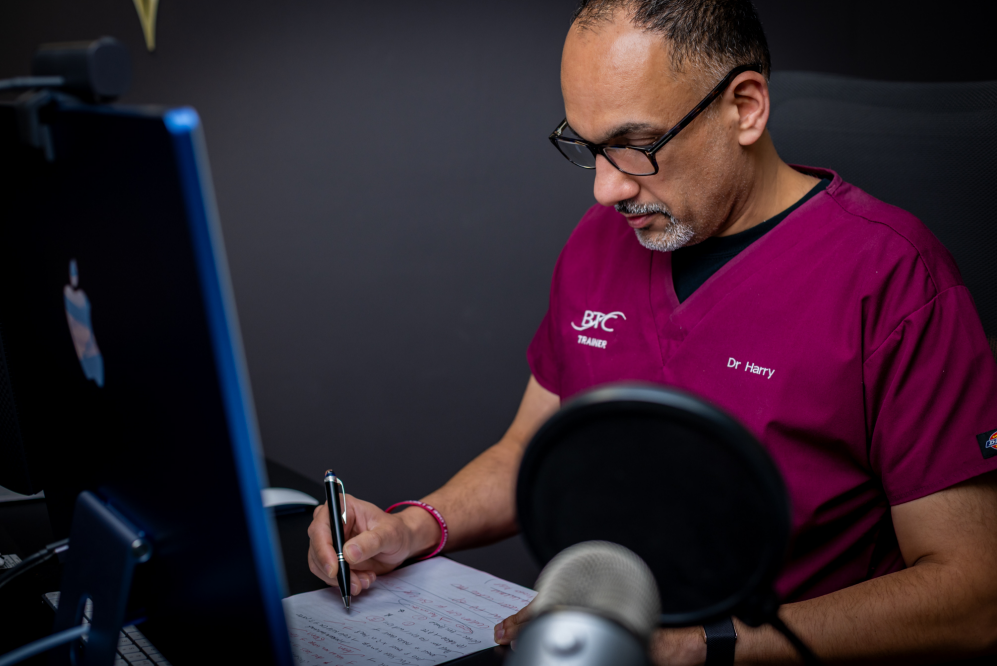
Yep. Me. The guy running aesthetics training, selling out courses, mentoring hundreds… was once a red-faced wreck standing in front of a notice board of shame, squinting at his own name under the word “FAIL.”
I wasn’t dumb. I just had disgustingly poor study habits. Classic arrogant coasting. I’d always done well at school, skated through with a mix of charm, cramming and caffeine. Finals? Pfft. I thought I could do the same.
Nah.
Finals aren’t GCSEs. You can’t blag functional anatomy on 3 hours sleep and a chicken tikka wrap. You can’t “vibe” your way through written papers that determine your entire career trajectory.
I rocked up to those exams underprepared, under-rested and overconfident. And life smacked me straight in the mouth.
The Paper on the wall
Nothing prepares you for seeing your name on a FAIL list. It wasn’t just embarrassment. It was public. Everyone saw it. I swear even the cleaner gave me a pity nod.
I remember the exact sound of the notice board flapping in the wind.
Colleagues tried not to stare. I tried not to vomit. Family was shocked—this was the straight-A kid who breezed through school. I’d always been the “smart one.”
The Mental Spiral
I genuinely thought life was over. The catastrophic, end-of-the-world type of thinking. “I’ll never catch up.” “I’ll be left behind.” “I’m unemployable.”
Complete bollocks, obviously. But in the moment, it felt real. Like I was falling into a crack no one could pull me out of.
I avoided people like I had leprosy. Didn’t want to talk about it. Didn’t want the pity. Definitely didn’t want the advice.
But a funny thing happened…
Some colleagues—bless ’em—were amazing.
Supportive, quiet, present. No big speeches, just enough kindness to keep me from drowning.
Summer of Pain, Growth and Sweet
I didn’t wallow. I flipped the switch.
That summer, I turned into a man possessed. I studied like a lunatic and trained like a Navy SEAL. Books in the morning, gym in the evening. Every day. No excuses. No distractions.
And it clicked: discipline in one area bleeds into others.
The fitter I got, the better I studied. The clearer I thought, the more confident I became. Success isn’t a sudden boom. It’s a series of tiny, boring reps you do while no one’s watching.
That’s the lesson.
The Comeback Was Better Than The First Try
I passed the resits. But more importantly—I came back sharper, stronger and humble as hell.
I landed an amazing VT scheme. Met my future business partner. Got a local job that changed everything.
If I hadn’t failed, none of that would’ve happened.
It was a f*cking blessing in disguise.
Here’s The Truth Nobody Tells You
The “clever” ones don’t always win. The textbook nerds? Great on paper.
But success in aesthetics, business, and life? That comes from different muscles:
And let’s be clear—failing your finals doesn’t define you.
It reveals you.
The Quick Win For You
If you’re in the middle of a breakdown, burnout or business implosion—good. That’s where the real learning starts.
Stop chasing hacks. Life’s a bloody marathon. Show up. Put the reps in. Set tiny daily goals. Read a page. Do a workout. Make one call.
That’s how you rebuild.
The Final Question
If success is really built in the shadows—what part of your life right now needs less spotlight and more sweat?
Think about it.
Then go get dirty.
Section 3: Action Points

FROM FAILURE TO F*CKING FOCUSED
Action: Write down exactly what went wrong. Don’t sugarcoat it. Be specific.
- Was it laziness? Arrogance? Avoidance? Lack of planning?
- What part was in your control that you f*cked up?
How: Do a brutal 15-minute journaling session with one rule: no blaming external shit.
Why it works: Accountability is the beginning of growth. You can’t change what you pretend wasn’t your fault.
Reflection Question: What’s more painful—admitting I failed or staying in denial and repeating it?
Action: Pick 2 non-negotiables you will do every damn day for the next 30 days:
One mental (e.g. revise 1 topic, read 10 pages)
One physical (e.g. 30 mins walking, 50 push-ups, weights)
How: Schedule these like meetings. No motivation required—just show up. Track it on paper. Cross off each day.
Why it works: You’re rewiring your identity from “lazy underachiever” to “disciplined machine.” Action over intention.
Reflection Question: If I had a camera crew following me, would my habits match my goals?
Action: Map the next 90 days. Mark what needs to be retaken, rebuilt or recovered. Break it down into:
- Week 1–2: Damage control (what needs redoing?)
- Week 3–6: Recovery (study/work/deep execution)
- Week 7–12: Rebuild momentum (fitness, network, self-image)
How: Use a whiteboard or spreadsheet. Visual clarity = emotional stability.
Why it works: Without a time-based plan, failure just feels like freefall. Structure gives you psychological safety.
Reflection Question: What would “comeback season” look like if I treated it like a mission, not a punishment?
Action: Document everything you’re learning from this failure.
- New habits.
- What to never do again.
- Who showed up for you.
- What you won’t tolerate anymore.
How: Voice notes. Notion doc. Journal. Doesn’t matter. Capture it. Keep receipts of your growth.
Why it works: Most people make the same mistakes twice because they don’t document the first one.
Reflection Question: If I read this file a year from now, would it make me
proud—or piss me off?
Action: Reach out to someone who’s failed and bounced back. One DM, one call, one honest chat.
How: Ask this question: “What did you wish you’d done immediately after failing?”
Why it works: You shortcut years of wandering by learning from someone else’s bruises.
Reflection Question: Am I surrounding myself with people who normalise growth or glorify comfort?
Quick-Win Exercise: 5x5x5 System
- 5 minutes writing: What did I do today to get better?
- 5 minutes planning: What’s tomorrow’s ONE task?
- 5 minutes movement: Anything. Walk. Pushups. Dance like a maniac.
Why it works: Simplicity creates consistency. And consistency beats brilliance every time.
Final Question To Burn Into Your Brain:
Coming up next week:
Welcome to this week’s no-fluff recap — where we tear apart lazy trends, challenge industry fluff, and share what it actually takes to perform at the highest level in aesthetics, business, and life.
Section 1: Clinical Mythbusting
(AKA: How the industry convinced itself that charging more for doing less is a virtue.)
The aesthetic world’s latest obsession?
Baby Botox. Microdosing. Subtle tweaks.
The problem?
We’ve confused minimalism with mastery. Injectors are proudly squirting 1 unit per site and acting shocked when their 26-year-old patient says: “I still look the same — just poorer.”
Let’s be clear: Microdosing isn’t a revolutionary technique — it’s an avoidance strategy. A way to dodge responsibility, real anatomy and patient expectations.
- "It looks more natural” – Only when done by someone who actually understands muscle balance. It’s not the dose. It’s the doer.
- “It’s better for young patients” – Wrong. Young = stronger muscles. They need smart dosing, not diluted nonsense.
- “It’s safer” – No. 100 superficial blebs = 100 opportunities to bruise, nick and disappoint.
Where microbotox does shine: skin texture, pore size, oil control, neck lines — and only as an adjunct to proper dosing.
Final truth: You’re not a better injector because you underdose. You’re just a
less effective one. Stop hiding behind “subtle” when you mean “ineffective.”
Section 2: Harry’s Honest Hour
This week, I opened up about a decision that surprises a lot of people — even makes some uncomfortable:
I use a life coach.
Not because I’m lost.
Not because I’m spiralling.
Because I wanted more.
I wasn’t in crisis — but I wasn’t in flow either.
I was productive… but not potent.
Ideas everywhere… but not landing deep enough.
And when you’re an operator, a creator, a mentor — you need space to think
sharper, act faster, and build with intention.
That’s what coaching gave me:
- Focus over friction
- Clarity over chaos
- Fewer projects, deeper results
The best question my coach ever asked me?
“Do you want to be productive — or potent?”
Since then, I’ve cut vanity projects, protected my thinking time and learned
to say no to things that don’t build real legacy.
And let’s kill this myth once and for all:
Coaching isn’t therapy.
It’s not a crutch.
It’s a strategy for high-performers who refuse to coast on default.
If you think you’re “too good” for a coach… you’re probably the one who needs it most.
Section 3: Strategic Practice Moves
“Stop Babysitting With Baby Botox – Your 5-Step Action Plan”
In this week’s Strategic Moves section, we went from theory to action tearing down the microdosing madness and replacing it with a practical, powerful clinical strategy.
Here’s your no-nonsense playbook:
→ Pores? Texture? Fine neck lines? Fine. But don’t use it to fix glabellar lines.
→ You’re not safer if the patient sees no result. You’re just postponing the complaint.
Quick-win challenge of the week:
Ban the phrase “Baby Botox” from your vocabulary.
Replace with: “We’re using a lighter dose here, based on functional movement — not age.”
That’s how you position yourself as an expert, not a trend follower.
Final World
This week we tackled three kinds of underperformance:
- Under-injecting clinically
- Under-investing in yourself professionally
- Under-delivering results by confusing dilution with design
If there’s a takeaway from all three?
Stop doing less and calling it more.
Stop hiding behind subtle.
And stop thinking help = weakness.
Whether it’s your technique, your mindset, or your strategy — the boldest move you can make right now?
Go deeper. Commit harder. Play bigger.