The Aesthetic Contrarian Weekly Recap - Filler Migration, Money and Materials

Section 1: Clinical Mythbusting
Filler migration isn’t just about overfilling—it’s about bad technique, wrong planes, poor product choice, movement, old filler left to rot, and injectors too lazy to reassess or dissolve; blaming volume is a cop-out that protects egos, not patients, and if your filler keeps “moving,” maybe it’s time to admit it’s not the HA that’s drifting—it’s your damn standards.
Section 2: Harry’s Honest Hour
I chased money, status, and shiny sh*t thinking it meant success—until I realised none of it fills the void when there’s no connection, no impact, no legacy; the real wealth isn’t in your Stripe account or your Rolex, it’s in the lives you touch, the values you live, and whether anything you built would still matter if your bank balance disappeared tomorrow.
Section 3: Strategic Practice Moves
Stop blaming filler volume when it’s your technique that’s sh*t, and stop chasing flashy crap that feeds your ego but starves your soul—start mapping your injections properly, owning your complications, building services that actually help people, and if your calendar’s full but your values are bankrupt, congratulations: you’ve built a business that’s profitable but pointless.
The Evidence Check

“Migration Nation: The Filler Didn’t Just ‘Move Because You Overfilled It’”
(Welcome to the myth that keeps botched lips and swollen cheeks in business.)
Let’s settle this once and for all.
Filler migration is NOT just about overfilling.
And if that’s the only explanation you’ve been taught, you’re either being lied to or you stopped paying attention after your foundation course.
Yes, overfilling can cause migration.
But so can poor placement. So can injecting in the wrong plane. So can product choice, lymphatic flow, movement, scar tissue, even the patient’s own damn anatomy.
The “it migrated because she had too much” excuse is the aesthetic equivalent of saying “Mercury’s in retrograde” — vague, unhelpful, and usually a deflection from your own sh*t technique.
MYTH SPOTLIGHT: “Migration = You Put in Too Much”
Here’s how the lazy logic goes:
- “Your lip filler migrated above the vermillion border? Must’ve been too much product.”
- “Cheeks looking heavy and moving medially? Must’ve been overdone.”
- “Tear trough now a puffy under-eye slug? Definitely too much filler.”
Injectors love this myth because it protects their ego and silences patient complaints. If it was just about quantity, then “less is more” becomes the only fix.
But here’s the truth: technique is the problem more often than volume is.
REALITY CHECK: FILLER MIGRATES FOR A WHOLE LOT OF REASONS
Let’s look at what the literature and real-life experience actually say:
Plane Misplacement
Injecting superficially into dynamic areas = migration magnet. You want retro-orbicularis-oris placement in the lips? You better hit it. Otherwise, that HA’s taking a scenic tour into the white roll.
Product Choice
Not all fillers integrate the same. High G-prime in the wrong area = rigidity, movement, puffiness. Use a robust product where you need pliability, and migration’s almost guaranteed.
Mechanical Forces
Talking, chewing, smiling, kissing — all apply pressure. Inject into an area that’s constantly moving without accounting for that, and your precision becomes pudding.
Lymphatic and Vascular Flow
Poor lymph drainage = swelling + sluggish dispersion. Especially around the eyes and lips. This isn’t about “too much,” it’s about poor circulation and filler going for a wander.
Scar Tissue and Repeated Injecting
Old filler left in place = new filler displaced. Scarred planes = unpredictable flow. Migrated filler doesn’t always mean fresh error — sometimes it’s historical build-up no one ever corrected.
Enzymatic Degradation Is Not Linear
Hyaluronic acid doesn’t disappear neatly. It fragments. Partially broken-down filler can shift as the body metabolises it. Especially if it’s been sitting there for 12 months in a half-collapsed space.
EVIDENCE TIME:
- Goldberg & Fabi (2018): Discussed the biomechanical behaviour of HA fillers and emphasised how movement and product rheology affect stability — not just volume.
- de Boulle & Heydenrych (2015): In their filler complications paper, they highlight “plane, pressure, and placement” as core drivers of migration — not just total ml injected.
- King et al. (2020): Found in a retrospective review that patients with perioral migration had normal volumes, but consistent shallow placement across sessions.
TRUTH BOMB: IF YOUR FILLER MIGRATES, IT’S USUALLY A TECHNICAL PROBLEM.
Let’s be real. Most migration cases come down to:
- Rushing
- Not aspirating
- Using one technique on every lip
- Not properly dissolving old filler
- Being scared of depth
- Being addicted to linear threading like it’s 2012
And let’s not forget… lying to the patient.
How many times has someone come to you with migrated product and said, “My injector told me it was swelling”?
Weeks later, they’re still puffy. Still misshapen. Still gaslit.
It’s not swelling. It’s migration.
And it’s not from overfilling. It’s from poor judgement.
THE WORST PART? MIGRATION HAS BECOME NORMALISED.
Lips with shelfing above the vermillion? “That’s just product retention.”
Under-eye bags that weren’t there before? “It’s a hydration phase.”
Cheeks with medial bulge? “Totally natural — we followed your bone structure.”
We’ve stopped being honest. Because we’re scared of dissolving. We’re scared of starting over. We’re scared of admitting fault.
So instead we say: “Too much.”
When the truth is: “Wrong plane.”
Or: “I didn’t account for tissue resistance.”
Or: “I used the wrong filler in the wrong place.”
THE DOWNSIDE OF BLAMING VOLUME:
You Undermine Real Clinical Learning
Blaming volume gives injectors a false sense of safety — like they can “microdose” their way out of poor technique.
You Scare Patients Into ‘Less Is More’ Extremes
Patients start rejecting full correction out of fear. Under-treated faces, multiple sessions, no actual result. Waste of time and trust.
You Avoid Accountability
If you never address why your filler moved, you never improve. You just keep injecting in the same shallow, mobile plane and hoping for a different outcome.
WHAT TO DO INSTEAD: ACTUAL MIGRATION PREVENTION STRATEGY
Know Your Planes
For lips: retro-orbicularis-oris. For tear troughs: sub-orbicularis. For cheeks: supraperiosteal or sub-SMAS depending on depth needs. Stop “guessing shallow” and hoping it sticks.
Use the Right Product in the Right Place
Low G-prime, high stretch fillers go in dynamic zones. Save robust HA for structure zones. Read the data sheet. If it feels like glue, don’t put it in a mobile area.
Respect the Anatomy + Movement
If the patient’s a heavy chewer, big smiler, or talks like they’re auditioning for Love Island — you can’t use static filler logic.
Clear the Slate Before Rebuilding
If you suspect migration, dissolve first. Then re-assess tissue. You wouldn’t build a house on a swamp — don’t inject over old mess.
THE HARD TRUTH? MIGRATION IS A SYMPTOM OF STANDARDS SLIPPING.
It’s not about the 0.1ml you went over.
It’s about the 3 steps you skipped.
The lazy rebooking. The “top-up” culture. The patient pressure. The “quick win” injection with no plan.
And now?
The lips are shelfing.
The tear troughs are bloated.
The cheeks are drifting toward the nose.
BOTTOM LINE:
Migration is NOT just about volume.
It’s about bad technique, bad product choice, and bad clinical thinking.
If you’re still using “overfilled” as your go-to excuse for movement — you’re not protecting your patient, you’re protecting your ego.
Question to Ponder:
Do you actually know where your filler’s sitting… or are you just hoping it stays put?
Section 2: Harry’s Honest Hour:
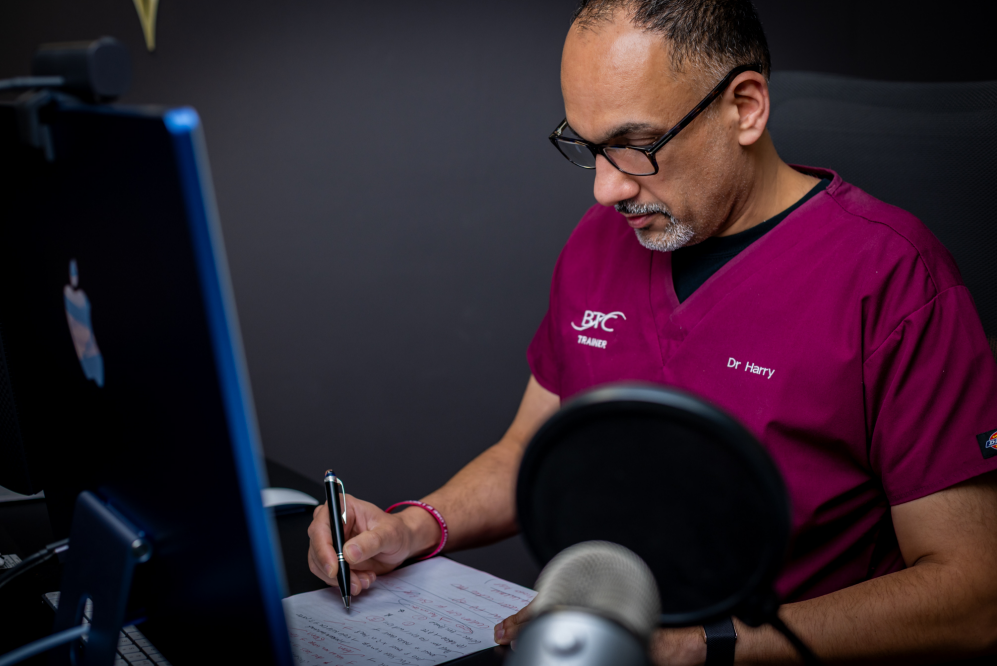
“I Thought Money Was the Goal. Turns Out, It Was Just a Distraction.”
(A brutally honest chat about chasing stuff, and what really matters when it’s quiet.)
Let’s rewind a few years.
Clinic growing. Courses selling. Speaking gigs booked.
Money flowing. More patients, more injectors, more status.
I was hungry. For what? Freedom, I told myself. But let’s be real — I wanted the trappings.
Nice watch? Got it.
Designer kicks? Why not.
Flash car? Check.
Big house? Of course — what else was I working this hard for?
Every month, I’d tick another item off the “success checklist” — and post it online like it meant something.
But here’s the thing I didn’t post: the silence that came with it.
The dull, echoing “meh” of getting what you wanted… and feeling nothing.
CONFESSION CORNER: I WAS OBSESSED WITH MONEY.
Not because I’m greedy. But because I thought it was the scoreboard.
More money = more impact.
More income = more respect.
More clients = more significance.
I built systems to scale.
Automated everything.
Turned my work into machines that pumped cash while I slept.
And you know what happened?
I woke up with more cash than ever…
… and a gnawing feeling that something was off.
I’d never felt so unfulfilled.
REALISATION: MONEY’S A TOOL — NOT THE POINT.
You know what snapped me out of it?
A conversation with a patient. She was late 60s, terminally ill, wanted “a little refresh to feel like herself.” We talked for 40 minutes. About life. Kids.
Regrets. She didn’t care about money. She cared about legacy.
That night I stared at my bank account and asked:
“If I died tomorrow, what the hell would this even mean?”
Would anyone care how many clinics I opened?
How many £££ I’d pulled in that quarter?
Or would they remember how I made them feel?
TRUTH: MATERIALS DON’T MEAN SH*T WITHOUT CONNECTION.
I started noticing things:
- How many “successful” people were lonely as hell
- How many of my proudest moments weren’t about income, but impact
- How good it felt to see someone grow — not just buy
That old dopamine hit I used to get from money? Replaced by the quiet satisfaction of:
- Seeing a mentee find their voice
- Hearing a patient say, “You gave me confidence back”
- Watching a team member grow into a leader
That’s wealth.
The stuff you can’t flex on Instagram.
The stuff no algorithm rewards.
MONEY’S NOT BAD — IT’S JUST NOT ENOUGH.
I’m not here to say don’t make money.
Make all the money you want.
Be profitable. Be smart. Be paid what you’re worth.
But do not confuse profit with purpose.
Because once your bills are paid, and your debts cleared, the next £10k doesn’t fix what’s broken inside.
It doesn’t make up for missed time with family.
It doesn’t replace the joy of building something meaningful.
And most of all:
It doesn’t build your legacy.
WHAT I DID AFTER THE SHIFT:
Now every project I take on has to tick 2 boxes:
– Will it help someone long-term?
– Will it feel good doing it?
If the answer’s no — I bin it. No matter how lucrative.
We celebrate outcomes. Not just revenue.
I ask staff what lights them up — not just what fills the diary.
Because happy teams = happy patients.
And happy patients = a business that lasts.
With patients. With colleagues. With myself.
I ask what matters to them beyond aesthetics — and then try to honour that in how I treat, coach, and lead.
WHAT I LET GO OF:
- Flashy launches that were just noise
- Collaborations that looked good but meant nothing
- The need to prove anything to anyone
WHAT I GAINED:
- Deeper relationships
- More loyalty
- Less burnout
- A business that actually feels like mine
QUICK WIN FOR YOU: ASK THIS RIGHT NOW:
- If you lost your Instagram and income tomorrow — what would still be true about your impact?
- If no one clapped for you, posted you, or validated you — would you still be proud of how you show up?
- If your kids/family/staff watched how you run your clinic — what would they actually learn?
Have you been chasing success… or designing your legacy?
There’s a difference. One fills your Stripe account.
The other fills your soul.
CITATIONS FOR PSYCHOLOGICAL CONTEXT:
- Journal of Positive Psychology (2017): “Sustainable Wellbeing is Rooted in Meaning, Not Material Wealth”
- American Psychologist (2019): “Materialism Correlates Negatively With Life Satisfaction and Purpose”
Section 3: Action Points

“Fix Your Technique, Then Fix Your Priorities: The Anti-BS Blueprint”
Take baseline photos, annotate common danger zones (white roll, tear trough, malar medial cheek). Every patient. Every time.
Quick Win: After 4–6 weeks, review outcomes. If filler shifted, ask: Was it really volume—or was it placement, plane, or pressure?
Reflect: Are you observing change or just defending old technique?
Normalise dissolving. Create protocols where migration = plan, not panic. Educate patients that sometimes less isn’t safer—it’s sloppier.
Quick Win: Write a “migration myth” patient leaflet explaining what it is, why it happens, and how you treat it.
Don’t get stuck in 2018 injecting habits. Learn cannula and needle-based refinements. Challenge your default technique.
Ask: When was the last time I audited my injection depth—not just my ml usage?
Every Sunday, ask: Where did I spend time last week? What earned money? What built meaning? What drained me?
Quick Win: Colour code your calendar — green = legacy, red = ego/vanity, grey = filler. Optimise for green.
Create one service, course, or project designed purely for impact — not income. Price it fairly. Market it honestly. Make it matter.
Ask: If this was my last year in aesthetics, would I be proud of this?
Strip “featured in,” “top 10,” “#BossLife” crap off your site. Replace with testimonials, real outcomes, stories that show who you are, not what you flex.
Quick Win: Replace your “About Me” page with a patient-first narrative. Tell them who you help and why, not what awards you bought.
Write down:
- The last filler complication you saw and what actually caused it
- The last purchase you made for your image — and whether it fed your soul
- One relationship (patient, team, mentor) that gives you meaning — and how you’ll nurture it next week
Do that every month. Your technique will sharpen. Your business will deepen. Your fulfilment will finally feel real.
CITATIONS:
- de Boulle & Heydenrych (2015), “Filler Complications: Causes & Prevention”
- King et al. (2020), “Perioral Filler Migration Review,” Aesthetic Surg J
- Journal of Positive Psychology (2017)
- American Psychologist (2019)
In next week’s edition:
THE EVIDENCE CHECK
- SKIN BOOSTERS CAN STILL CAUSE VASCULAR OCCLUSION (0.001–0.05% risk) – low-viscosity ≠ zero risk.
- MASTER ANATOMY, USE CANNULAS, ASPIRATE & INJECT SLOWLY, & HYALURONIDASE ON HAND.
HARRY’S HONEST HOUR
- FB ADMINS ARE RACKETEERS: ego-driven, money-grabbing, inner-circle BS.
- DEMAND TRANSPARENCY & MEASURABLE OUTCOMES or DITCH THEIR PAY-TO-PLAY CIRCUS.
ACTION POINTS
- SKETCH & PALPATE VASCULAR MAPS BEFORE EVERY INJECTION.
- SWITCH TO MICROBURSTS (0.02–0.05 mL), EMBRACE CANNULAS, RUN MONTHLY VO DRILLS.
- STANDARDISE EMERGENCY KITS, PEER-AUDIT PROCEDURES & BUILD NO-BULL CONSENT FORMS.