
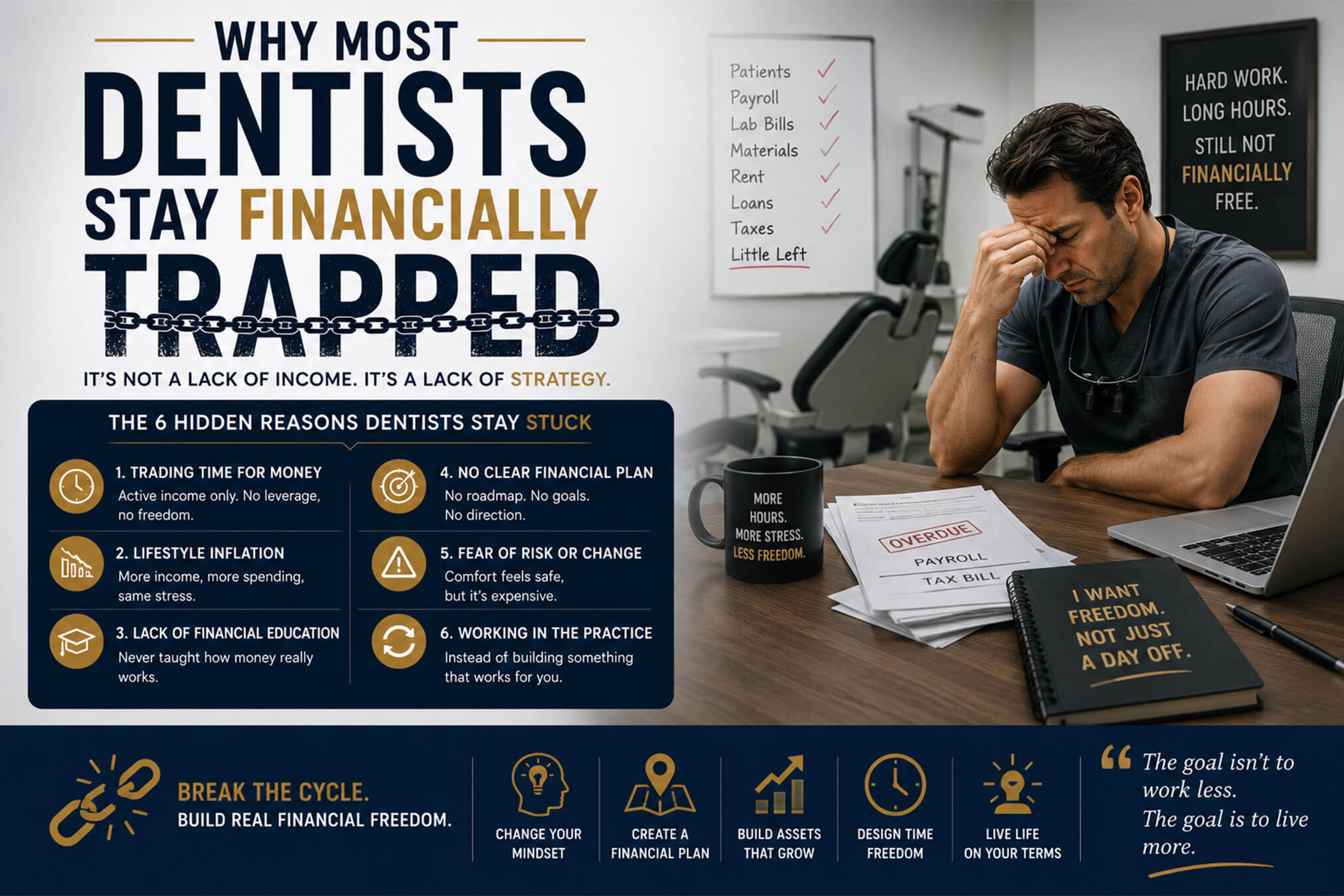
The Paradox Nobody Prepares You For
You entered dentistry to build a stable, prosperous life. That was the understood exchange: years of gruelling training, tens of thousands of pounds in debt, the relentless pressure of professional examinations and clinical placements — in return for a career that would reward your investment. Financial security. Professional respect. A good life.
And by almost every observable measure, you are doing well. Your income places you well above the national average. Your professional qualifications are real. Your patient relationships are often profound. You are, on paper, precisely the kind of person who should not be financially stressed.
So why, on a Sunday evening, does the weight of it still sit on your chest?
Why, despite earning what many would consider a very good income, does the money always seem to vanish? Why, despite years of hard work and clinical excellence, does retirement feel like an abstract concept rather than a concrete horizon? Why do so many dentists — highly educated, technically brilliant, financially conscientious — look up at forty-five and realise they are no closer to financial independence than they were at thirty?
This is the paradox that defines modern dentistry. High income. Low wealth accumulation. A profession that rewards skill, punishes passivity, and almost entirely fails to educate its practitioners in the mechanics of financial freedom.
This article is about understanding that paradox — not vaguely, not with platitudes, but with precision. Because the trap is not a mystery. It is a structure. And structures, once understood, can be redesigned.
The Trap Begins Before You Treat Your First Patient
The financial architecture of a dental career is compromised before it begins.
Mean total debt among final year dental students reached £52,922 in 2022 — more than double the figure of £24,734 recorded just a decade earlier in 2013. For students who self-funded private dental school or who came from lower socioeconomic backgrounds, the figure is considerably higher; student loans of around £100,000 are now commonplace among those who funded their studies independently. A graduate tax of 9% on earnings above the threshold kicks in from day one of clinical practice — on top of income tax, National Insurance, and all the other obligations of professional life.
This is the starting position. Not a blank sheet. Not even a level playing field. A financial hole, dug during training, before a single patient has been seen.
There is a compounding cruelty to this opening condition that deserves to be named. The interest on student loans is linked to inflation — meaning that for many graduates, despite making repayments every month, the principal balance increases rather than decreases. The loan does not behave like a conventional debt. It behaves, as money saving expert Martin Lewis has noted, more like a graduate tax — one that shadows you for most of your professional life regardless of how diligently you attempt to pay it down.
Entering a career with this financial weight is not simply a logistical inconvenience. It is a psychological conditioning. It teaches, from the outset, that professional effort produces income, and that income immediately disappears into obligation. The cycle — work, earn, repay, repeat — is established early. And for many dentists, it simply never stops.
The UDA Ceiling: A Contract Designed for Extraction, Not Elevation
For the majority of UK dentists who build their early careers in NHS practice, the primary financial constraint is not their own limitations — it is the structure of the contract under which they work.
The NHS UDA (Unit of Dental Activity) contract, introduced in 2006, replaced the previous fee-per-item model with a fixed, target-based system. The stated intention was to improve access and simplify administration. The actual outcome, as practising clinicians have understood for nearly two decades, was the creation of a system that structurally caps the upside of clinical effort while loading the downside risk entirely onto the practitioner.
Consider the mechanics. Under the UDA model, a dentist is contracted to deliver a specific volume of activity for a fixed sum. If they deliver less, they face clawback — financial penalties for underperformance. If they deliver more, they receive no additional reimbursement beyond marginal improvements at the edges. The incentive structure is, in practice, a ceiling. More effort does not produce more income. Better clinical outcomes do not produce more income. Patient satisfaction does not produce more income. Only volume, within a fixed band, produces income — and that income is predetermined regardless of what the clinician does.
The British Dental Association has described the contract as unfit for purpose. The 2024 Dental Recovery Plan — the government’s most recent intervention — did not, according to NHS England’s own data analysis, increase UDA delivery in 2024/25. The contract has been reformed, reviewed, and consulted upon more times than most practitioners care to count, and yet its fundamental structure — the active income ceiling — remains intact.
This is not a political observation. It is a financial one. A dentist working within the NHS UDA system is not building wealth. They are trading time for a fixed rate of return, within a structure that has no mechanism for upward mobility. The hardest-working, most clinically excellent NHS dentist in the country earns essentially the same as a competent, averagely committed one. That is not a system that rewards ambition. It is a system that punishes it by making it irrelevant.
The Lifestyle Creep That Nobody Warned You About
Here is a dynamic that receives very little honest discussion in dental professional circles — and that quietly accounts for as much financial damage as the UDA contract or the student debt burden.
Dentists are high earners who spend years not earning. Dental school is five years of deferred gratification, watching friends in shorter degree programmes enter the workforce, begin earning, begin building the visible markers of adult prosperity — the flat, the car, the holidays — while you remain in clinical training. The psychological accumulation of that period is real, documented, and widely underacknowledged.
By the time qualification arrives, there is a powerful, largely unconscious pressure to close the gap. To begin living at the level that your qualifications — your five years of sacrifice — seem to justify. The car. The house. The lifestyle. Not extravagance, necessarily. Just the quiet, entirely reasonable sense that you have earned the right to live well.
This is how lifestyle inflation begins. Not dramatically. Not recklessly. Gradually, incrementally, almost invisibly — what financial advisors call lifestyle creep. Income rises; expenditure rises with it, or faster. Each upgrade to the standard of living feels justified in isolation. Collectively, they construct a fixed cost base that quickly matches, and then threatens to exceed, the income that sustains it.
Research suggests that roughly one third of individuals earning what would be considered a high income still live paycheck to paycheck. Among dentists specifically, lifestyle inflation represents one of the primary mechanisms through which otherwise substantial incomes fail to translate into meaningful wealth accumulation. High income and asset-poor is not a rare pathology. It is one of the most common financial profiles in professional dentistry.
There is a clinical analogy worth making here. A patient who presents with periodontitis did not develop it in a single appointment. It accumulated — slowly, below the threshold of acute pain, producing damage that was invisible until it was advanced. Lifestyle creep behaves identically. By the time the financial consequences become visible, the structural problem is already well-established.
The £100,000 Tax Trap: Earning More, Keeping Less
One of the most counterintuitive — and underreported — financial experiences in modern dentistry is the phenomenon of earning more and taking home less.
As income crosses the £100,000 threshold, a cascade of tax-related changes is triggered that can, for dentists with children and complex income structures, produce an effective marginal rate that exceeds what most practitioners would regard as reasonable. The personal allowance begins to taper. Childcare entitlements reduce or disappear entirely. Tax-free childcare support becomes inaccessible. The compound effect of these changes, particularly for dentists with young families, can mean that a meaningful increase in clinical income produces virtually no improvement in net take-home pay.
This is not an edge case. Dental Elite, one of the UK’s leading dental industry firms, has reported that dentists are increasingly managing their income specifically to avoid crossing the £100,000 threshold — delaying dividends, restructuring income, or even reducing clinical sessions to avoid triggering higher marginal rates or losing access to childcare support.
The implication of this is profound, and it points to a systemic failure of financial planning education within the profession. The tax system, as it applies to the income profiles of typical dental professionals, is not intuitive. It is not what most dentists would predict from their clinical earnings. It requires active, sophisticated financial planning — the kind that dental school never provides, and that many practitioners discover only when they have already been exposed to its consequences.
The trap, in other words, is not just that income is capped at the bottom of the earnings range by the UDA structure. It is also that income is structurally penalised at the upper end by a tax architecture that dentists are almost never taught to navigate.
The Financial Literacy Gap That Clinical Training Creates
At the intersection of all these pressures lies a foundational problem that precedes and enables all the others.
Dentists are among the most highly educated professionals in the United Kingdom. Their clinical training is among the most rigorous, the most practically demanding, the most knowledge-intensive of any degree programme. They graduate understanding anatomy, pharmacology, radiography, oral pathology, and the biomechanics of occlusion to a depth that most professions cannot match.
They do not graduate understanding compound interest. Cash flow. Passive income. Asset allocation. Leverage. Tax structuring. Portfolio construction. The difference between income and wealth.
This is not a criticism of dental school curricula — clinical training has a legitimate scope, and personal finance is outside it. But the consequence is that dentists enter the profession not just with significant debt, but with almost no framework for managing the transition from high income to genuine financial independence. They know how to earn. They do not know how to build.
Most adults earning six figures were never taught how money actually works — and the observation applies as directly to dentists as to any other profession. Research consistently shows that financial literacy does not correlate with income level; high earners are just as likely to make structurally poor financial decisions as moderate earners, often at a larger scale and with greater consequences.
For dental professionals, this literacy gap produces specific, predictable patterns. Pension contributions that begin too late, at too low a level, to generate meaningful retirement security. Practice ownership structures that maximise clinical output but create minimal transferable equity. Income held in accounts rather than deployed into appreciating assets. No mechanism for generating returns during the periods — illness, maternity, holidays — when active clinical work is not possible.
There is a particular concept gaining traction in financial commentary that resonates strongly with the dental experience: money dysmorphia — a psychological disconnect between actual financial position and perceived financial precarity. Dentists often earn well enough to be objectively comfortable, yet feel financially squeezed, financially behind, financially at risk. The feeling is not always irrational. Rising overheads, student debt interest, tax complexity, and lifestyle obligations create genuine cash flow pressure even at high income levels. But the feeling can also mask an underlying financial position that, with intelligent management, is considerably stronger than it appears.
The problem is that without financial education, dentists cannot distinguish between the two. They cannot identify which pressures are structural — requiring systemic change — and which are perceptual — requiring reframing and planning.
The Single-Point-of-Failure Problem
There is a structural vulnerability that underpins almost every other form of financial stress in dentistry, and it deserves to be named with precision.
A dentist’s income, in its default configuration, depends entirely on the dentist’s physical presence in a surgery.
Stop working — through illness, injury, burnout, or simply because you choose to — and the income stops. This is the definition of a single-point-of-failure income architecture. Every pound of financial security you have built, every obligation you are meeting, every lifestyle commitment you have made — all of it is suspended on a single thread: your ongoing ability and willingness to be chairside.
The pandemic made this vulnerability legible in a way that years of financial advice had failed to do. Practices closed. Active income — the only income most dentists had — simply ceased. For practitioners with no financial infrastructure beyond their clinical earnings, the disruption was catastrophic. For the minority who had already begun building parallel income streams — property portfolios, investment income, aesthetic revenue — the disruption was deeply uncomfortable but financially survivable.
The lesson was not that dentistry is fragile. The lesson was that monoculture income is fragile. Any system dependent on a single source of return is, by definition, fragile — vulnerable to any disruption that affects that single source. Diversification is not a luxury. It is the basic architecture of financial resilience.
High-earning dentists who remain asset-poor do so, in many cases, not because they lack the capital to invest — but because they have never constructed the cognitive framework, the knowledge base, or the specific guidance that would allow them to deploy that capital productively. They earn. The earnings fund consumption. And consumption, unlike investment, does not compound.
The Identity Trap: Why Dentists Don't Think Like Wealth-Builders
There is a dimension to the financial trap that is less structural and more psychological — and arguably more difficult to address, because it operates below the level of conscious choice.
Dentistry, as a professional identity, is built around clinical excellence. This is not merely a career description. It is a self-conception. Dentists define themselves by their clinical skill, their patient relationships, their technical mastery. The value proposition of a dental career — as it is taught, modelled, and culturally reinforced — is clinical.
This creates a subtle but powerful constraint on financial thinking. Wealth-building activities — investing in property, building a business, developing a commercial income stream — sit outside the identity structure of clinician. They feel, to many practitioners, like distractions from the real work. Or worse, like admissions that the real work is somehow insufficient.
The result is a kind of professional narrowness that wealth-builders from outside the clinical professions would find remarkable. Highly intelligent, analytically capable individuals who would not hesitate to master a new clinical technique or invest in advanced postgraduate training — but who remain, year after year, entirely outside the financial systems that would give them genuine independence.
This is not laziness. It is identity. And identity is, in many cases, the most durable cage.
The dentists who break the financial trap are not, in most cases, uniquely financially gifted. They are not smarter or more ambitious than their peers. They are simply the ones who recognised that their clinical identity, however valuable, was a starting point — not a ceiling. They are the ones who understood that building financial independence is not a betrayal of clinical vocation. It is the condition that makes clinical practice sustainable, joyful, and freely chosen rather than financially compelled.
There Is a Way Out — But It Requires a Different Architecture
The financial trap that most dentists inhabit is not inevitable. It is structural. And structures, once understood, can be consciously redesigned.
The exit from the trap requires three specific shifts — not sequential options, but interlocking components of a coherent financial redesign:
First: Clinical income must be expanded beyond the UDA ceiling. Facial aesthetics — through platforms like the Botulinum Toxin Club — represents the most natural, most accessible expansion pathway available to dental professionals. Dentists already possess the anatomical knowledge, the clinical skill, and the patient trust that aesthetic training transforms into commercial capability. The £3 billion UK aesthetics market is not a side opportunity. It is the most direct route out of the fixed-ceiling income structure of NHS dentistry.
Second: Active income must be supplemented with passive income. Property investment — through the Dental Property Club — is the most structurally sound vehicle for building income that does not depend on clinical presence. It deploys existing assets (creditworthiness, professional income, accumulated savings) into appreciating structures that compound over time, decoupling financial security from the surgery chair. The Dental Property Club has been building this exact architecture with dental professionals since 1998 — not from theory, but from direct investment experience across multiple market cycles.
Third: The performance foundation must be restored and maintained. None of the above can be built effectively from a position of chronic depletion. The dentist who is running on empty — cognitively compressed, physically eroded, emotionally flat — makes worse financial decisions, pursues fewer opportunities, and tolerates the trap longer than is necessary. Performance Reset exists to address this directly: not as a wellness programme, but as a precision intervention that restores the cognitive capacity, physical resilience, and psychological clarity that intelligent wealth-building requires.
These three components — clinical expansion, financial architecture, and performance restoration — are not separate products for separate problems. They are the integrated response to a single, structural condition: the financial trap that the dental profession builds into its practitioners without their knowledge or consent.
The First Step Is Diagnosis
The most expensive mistake most trapped dentists make is not a financial decision. It is a diagnostic one. They identify the symptom — financial stress, income ceiling, wealth absence — without identifying the structural cause. And without identifying the structural cause, the interventions they pursue are palliative rather than corrective.
More clinical hours will not fix a single-point-of-failure income architecture. Better time management will not fix a lifestyle inflation problem that has been building for a decade. More savings will not fix the absence of appreciating assets. These are the right solutions to different problems, applied to the wrong ones.
The Clinician Freedom Scorecard — the diagnostic tool at the centre of the Dr Harry Singh platform — exists precisely to map this with clarity. It identifies, with precision, whether the primary constraint is clinical, financial, or performance-related. It tells you not just that you are trapped, but why — and therefore where the highest-value intervention lies.
The financial trap is real. The statistics confirm it. The structures enforce it. The professional culture reinforces it. But it is not permanent, and it is not unique to you. It is a known architecture with known exit routes — built, tested, and traversed by dentists who decided that clinical excellence deserved a better financial foundation than the profession, as currently structured, provides.
The question is not whether the exit exists.
The question is when you decide to take it.
Dr Harry Singh is the founder of the Botulinum Toxin Club (botulinumtoxinclub.co.uk), the Dental Property Club (dentalpropertyclub.co.uk), and Performance Reset (performancereset.co.uk). He works privately with ambitious clinicians who are ready to elevate — clinically, commercially, and personally.
References
- Student debt – where are we? - The Probe - ... debt saddled at the feet of the average final year dental student and recent graduate sat at £52...
- Are dental graduates being crippled with student debt? - LinkedIn - Perhaps the most staggering is the amount of debt new graduates are facing, where student loans of a...
- Are dental graduates being crippled with student debt? - Dentistry - The amount of debt new graduates are facing, where student loans of around £100k are now commonplace...
- NHS dentistry - where did it all go wrong? - The Lowdown - Despite a Select Committee condemning the dental contract as 'unfit for purpose', Rishi Sunak's clai...
- Data analysis: impact of the Dental Recovery Plan - NHS England - Finding: The Dental Recovery Plan did not increase delivery of UDAs (excluding those earned through ...
- Lifestyle Inflation: The High Blood Pressure of Money - Lifestyle inflation, otherwise known as lifestyle creep. It is the idea that as your income increase...
- Money Well Spent: How Dentists Can Buy Happiness - Part 2 - habits that separate high-income dentists who struggle financially from those who build lasting weal...
- Money Well Spent: How Dentists Can Buy Happiness - Part 2 - Many dentists experience stress from debt, high overhead, and lifestyle creep, which erodes both fin...
- The £100k tax trap: why earning more doesn't always mean taking ... - dentists earning over £100,000 and raising children can experience increased financial pressure rath...
- Financial Literacy Lacking in High-Income Earners - LinkedIn - Most adults earning six figures were never taught how money actually works. Not budgeting. Not taxes...
- The Long-Term Impacts of Financial Illiteracy - Planned Future - This blog outlines the long-term impact of being financially uneducated. Shedding light on the ways ...
- Financial Literacy & Economic Inequality | NEA - Teaching personal finance in schools has a long- term positive effect on students' financial literacy...
- 'Money dysmorphia': could you have it? - Dentistry.co.uk - Magdelena Harding explains the concept of money dysmorphia and how it could cause dental professiona...
- Property investment – the ideal passive income stream in 2021 - One of the great realisations for dentists in 2020 was that their income is not as rock solid as the...
- Among America's swelling ranks of moderate millionaires, few have ... - Dentists are emblematic of the moderate or midtier millionaire—U.S. individuals with $1 million to $...
- Dentistry is Shifting From Functional To Aesthetic and Wellbeing - Another reason dentists are adding beauty treatments is the financial opportunity. Cosmetic treatmen...