
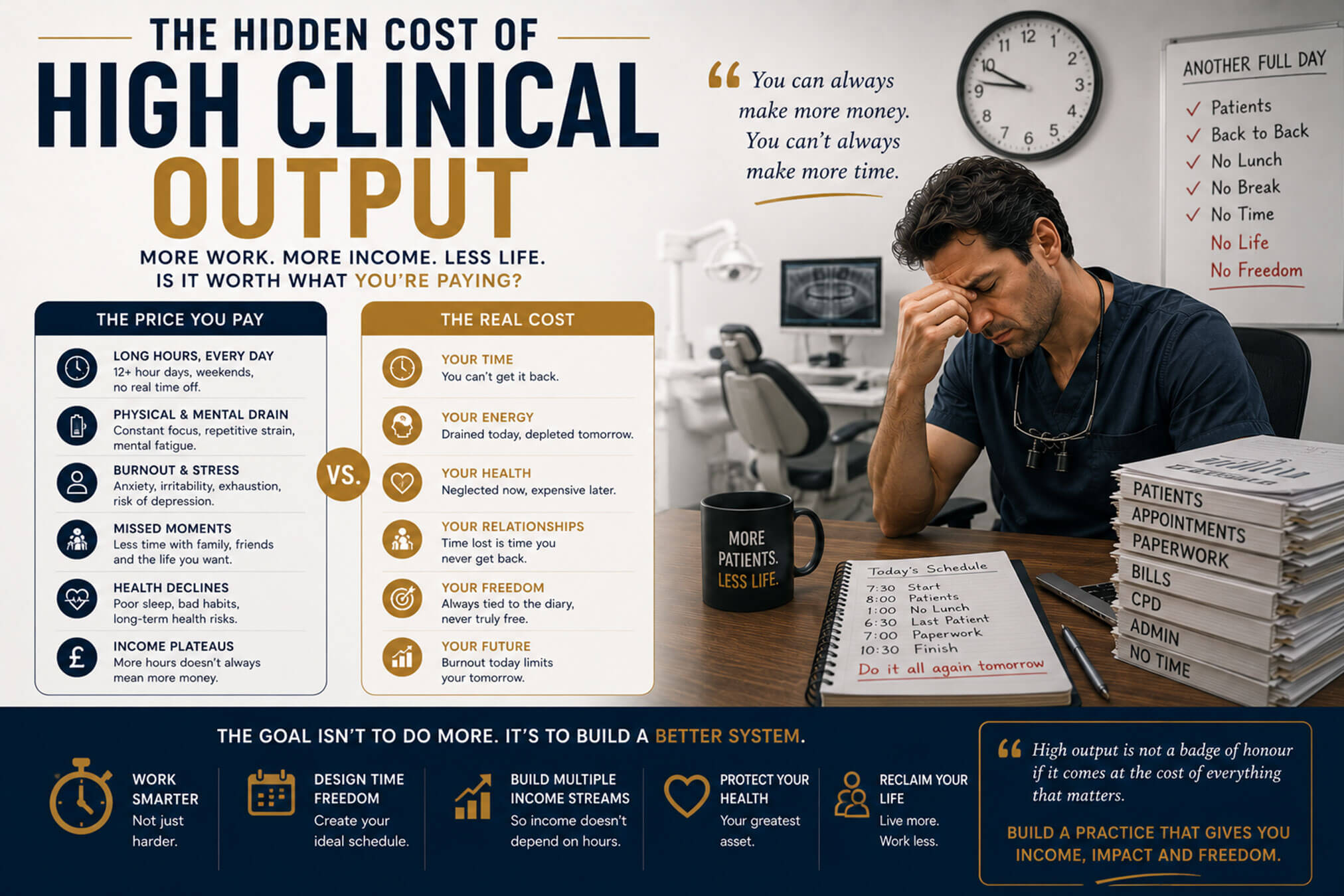
High clinical output is usually admired
A full diary.
Long days.
Strong production.
Consistent revenue.
A reputation for reliability.
A work ethic nobody can question
From the outside, it looks like commitment.
Often, it looks like success.
And sometimes it is.
But high output also has a cost profile that most clinicians never properly calculate. Not because they are incapable of seeing it, but because the profession rarely asks them to. Dentistry tends to reward visible production and ignore the invisible depletion that production can create.
So people measure what comes in.
They rarely measure what is being spent underneath.
That is where the hidden cost lives.
Output Has a Physical Price
Dentistry is not just skilled work. It is physically demanding work performed in constrained positions, under sustained concentration, for repeated periods, often with little real recovery between tasks.
That means output is not produced by effort alone. It is produced by the body.
The neck pays for it.
The lower back pays for it.
The shoulders pay for it.The wrists pay for it.
The jaw pays for it.
Sleep often pays for it too.
Many clinicians become so accustomed to low-grade tension, fatigue, tightness, and end-of-day pain that they stop treating these as warning signs and start treating them as normal. But normal does not mean free.
Every day of high clinical output creates some level of physical expenditure. Sometimes it is modest. Sometimes it accumulates quietly for years. Sometimes it becomes the thing that shortens a career long before technical skill or professional relevance ever would.
When the body is the primary instrument of income, physical wear is not a side issue.
It is a financial issue.
A career issue.
A performance issue.
And yet many dentists continue working as though output is pure gain, when in reality part of every productive week is being paid for with physical capital.
Mental Load Is Harder to See
The cognitive cost of high clinical output is often even less visible than the physical one.
Dentistry is not repetitive in the simple sense. It may involve similar tasks, but it demands constant decision-making. Every patient brings nuance. Every case brings judgment. Every plan involves risk, uncertainty, communication, and adaptation. Even routine work draws heavily on attention, fine control, pattern recognition, and executive function.
This means a high-output clinician is not just working long hours.
They are making hundreds of micro-decisions under pressure.
Treatment choices.
Communication choices.
Timing choices.
Risk judgments.Clinical prioritisation.
Documentation decisions.
People management decisions.
Emotional regulation decisions.
That kind of load accumulates.
And the more it accumulates, the more likely it is that quality of thinking starts to erode even while quantity of output remains high. The clinician is still delivering. Still functioning. Still getting through the list. But the internal experience becomes heavier. Simpler decisions feel harder. Patience becomes thinner. Creativity drops. Reflection shortens. Decision fatigue grows.
The professional may still look productive.
But their mind is carrying more weight than the diary reveals.
The Cost of Constant Availability
High-output clinicians are often praised for being “always on.”
They take on extra sessions.
They fit people in.
They stay late.
They work through lunch.
They absorb demand without complaint.
They become the person others rely on.
Again, this can look admirable.
But constant availability creates a subtle and dangerous professional pattern: the erosion of recovery as a real part of work.
Recovery becomes optional.
Breaks become compressible.
Boundaries become negotiable.
Presence outside work becomes thinner.
Mental recovery time becomes contaminated by unfinished cognitive load.
This matters because output only remains sustainable when it is paired with replenishment. A clinician who keeps giving without giving their system any meaningful opportunity to reset may continue performing for a while, but they are doing so by dipping into deeper reserves.
And deep reserves are not infinite.
Eventually the person notices they are no longer merely working hard. They are carrying work with them constantly. They are recovering less effectively. Their best energy belongs to the profession. Their leftover energy belongs to everything else.
That is not a neutral arrangement.
It changes the texture of life.
The Opportunity Cost Is Often the Biggest One
There is another hidden cost of high clinical output that almost nobody measures properly:
What high output prevents.
When a clinician is running at or near full capacity all the time, they may be earning well, but they are also using up the very resources required to build anything beyond the current model.
Time is gone.
Cognitive bandwidth is gone.
Strategic thinking is thinner.
Creative thought is reduced.
Physical recovery is weaker.
Long-term planning gets postponed because immediate demand keeps winning
So even if the dentist knows they need to diversify, invest, build a better system, expand into facial aesthetics, explore property, or reset their performance, they often cannot access the internal space required to act intelligently.
This is the real paradox.
The very output that appears to create success can quietly prevent the next stage of freedom from being built.
A full diary may be producing income while simultaneously blocking leverage.
Strong production may be rewarding today while undermining tomorrow.
Hard work may be funding life while also preventing redesign.
That is the opportunity cost of high clinical output: not just exhaustion, but the non-creation of alternatives.
More Production Does Not Always Mean More Progress
One of the most dangerous assumptions in professional life is that more output automatically equals more progress.
Sometimes it does.
But sometimes more output simply means more dependence on the same mechanism.
If a dentist increases clinical production without improving financial structure, they may just become more dependent on maintaining that production.
If they increase working hours without investing the surplus into assets, they may become busier but not freer.
If they produce more while neglecting recovery, they may gain short-term income at the cost of long-term capacity.
This is why production must always be evaluated within a wider framework.
What is it producing besides revenue?
Is it generating options?
Is it creating surplus that is being turned into assets?
Is it being delivered in a way the body can sustain?
Is it leaving enough cognitive space to design a better future?
Or is it simply consuming the clinician at a faster rate?
Those are the questions high performers must ask if they want honest answers about where their career is really heading.
Sustainable Output Looks Different
The strongest clinicians over the long term are not necessarily the ones who produce the most in every season.
They are often the ones who understand how to protect capacity while still delivering high-quality work.
They think in terms of sustainability, not just stamina.
They protect recovery.
They understand leverage.
They build income beyond pure output.
They treat performance maintenance as part of professional responsibility.
They do not confuse self-extraction with dedication.
This is a more mature model of success.
It values output, but not blindly.
It respects work ethic, but not at the expense of architecture.
It understands that the goal is not simply to work hard enough to survive the system.
The goal is to build a life in which clinical work remains valuable without having to consume everything
else.
That requires a different type of intelligence.
Not just clinical intelligence
Strategic intelligence.
The Better Measurement
Most dentists already know how to track revenue.
Far fewer know how to track cost in the deeper sense
Not just practice costs or tax costs, but the personal cost of the way they work.
What is your output costing your body?
What is it costing your focus?
What is it costing your family life?What is it costing your recovery?
What is it costing your ability to think beyond next week?
What is it costing your capacity to build something freer?
These questions matter because they turn production from a vanity metric into a strategic one.
And once those questions are asked honestly, a clinician can begin to redesign rather than merely endure.
High clinical output is not automatically a problem.
But unexamined high clinical output can become an expensive substitute for freedom.
That is the hidden cost.
And the earlier it is seen, the easier it becomes to build differently.
Dr Harry Singh is the founder of the Botulinum Toxin Club (botulinumtoxinclub.co.uk), the Dental Property Club (dentalpropertyclub.co.uk), and Performance Reset (performancereset.co.uk).
References
- Flow state and peak performance - Zevo Health - This article explores flow state and how it has such a positive impact on performance and wellbeing ...
- The Psychology of High Performers: Understanding the Elite Mindset - They don't just believe in their ability to improve; they actively seek out challenges that push the...
- Development and validation of a flow state scale for healthcare ... - The flow state is referred to by various terms—such as optimal performance, peak experience, and wor...
- If I stop, who am I? Identity shifts for high performers who are tired of ... - Identity shifts can feel tender at first, especially for high performers who are used to being stron...
- Dentistry is Shifting From Functional To Aesthetic and Wellbeing - Another reason dentists are adding beauty treatments is the financial opportunity. Cosmetic treatmen...
- Multiple Streams of Income for Doctors - The White Coat Investor - Just as diversification in your portfolio is valuable, so is receiving income from uncorrelated, mul...
- Property investment – the ideal passive income stream in 2021 - One of the great realisations for dentists in 2020 was that their income is not as rock solid as the...
- Is passive income possible for dentists? | Dr. Ingrid Murra - LinkedIn - Is passive income possible for dentists? The answer is yes. Here's how to build revenue streams that...