A Profession at an Inflection Point
Something is shifting in British dentistry. Not gradually. Not incrementally. Seismically.
Nearly 9 in 10 UK dentists — 87% — have experienced symptoms of stress, burnout, or mental health problems. An extraordinary 86% report that their practice intends to leave the NHS within the next five years. The number of dentists providing NHS care in England fell by 10% in just two years, leaving the workforce at its lowest level since 2013. In the same period, 40 million patient appointments vanished — equal to an entire year of dental care, gone. And as of early 2026, almost one third of people in England are now using private dentists, with that figure rising sharply even among lower-income households who cannot find NHS care.
These are not data points from a profession in mild discomfort. They are the measurements of a profession in structural transformation — one that is actively, if messily, redefining itself in real time.
And yet, the dominant narrative — the one transmitted through training programmes, professional organisations, and the quiet expectations of the clinical environment — remains stubbornly unchanged. Work harder. Treat more patients. Complete more UDAs. Pursue more clinical qualifications. Be a better dentist.
More dentistry. Always more dentistry.
This article is a direct challenge to that narrative. Not because clinical excellence is unimportant — it is foundational, and it always will be. But because the future of dentistry, for the individual practitioner who wants to thrive rather than merely survive, is not being built in the surgery. It is being built in the spaces beyond it. And the dentists who understand this earliest will define what the profession looks like for everyone who follows.
The Old Covenant Has Broken Down
For several generations of dental professionals, the bargain was simple and understood. You train. You qualify. You take a list. You treat patients. The NHS provides the infrastructure, the patients, and a reliable income in exchange for your clinical service. You work within the system. The system looks after you.
That covenant no longer exists in any meaningful form.
The UDA contract — introduced in 2006 to simplify NHS dental delivery — has been described by the British Dental Association as unfit for purpose for nearly two decades. The system it created rewards volume, punishes quality, caps upside, and loads all clinical and financial risk onto the practitioner. It does not provide a pathway to ownership. It does not provide a mechanism for clinical ambition. It does not provide financial security that extends beyond the hours you are physically present in a surgery. In the most direct possible terms: it is a contract designed for extraction, not for the building of careers.
The NHS Dental Recovery Plan — the government’s most recent attempt to repair the system — produced no measurable increase in UDA delivery in 2024/25, according to NHS England’s own data. After years of consultation, review, and reform announcements, the structural contract remains functionally unchanged. The practitioners still bear the risk. The ceiling is still in place. The clock is still running.
The response among dentists has been, in aggregate, an act of institutional departure. Forty-five percent have reduced their NHS commitment since the pandemic, by an average of more than a quarter. Forty-five percent intend to go fully private. The percentage of people in England now using private dental services has risen from 22% to 32% in just two years — not because patients are choosing luxury, but because the NHS system can no longer service the demand.
What is being witnessed, across the data, is not a crisis. It is a transition. And transitions, however uncomfortable, create both space and necessity for something new to emerge.
Technology Is Changing What Being a Dentist Means
Before we can understand what the future of dentistry looks like, we need to honestly confront the most significant force reshaping it from within: technology.
Artificial intelligence is already diagnosing cavities and early periodontal disease more accurately than the human eye in controlled studies. Intraoral scanners have largely replaced messy impressions. CAD/CAM technology allows same-day restorations to be fabricated in-house rather than sent to a laboratory. 3D printing is enabling crowns, bridges, and clear aligners to be produced within a single appointment. Predictive algorithms now analyse a patient’s radiographic and medical history to flag conditions before symptoms appear.
The Association of Dental Groups identified AI and digital innovation as one of the three seismic shifts that will define UK dentistry over the next fifteen years — alongside demographic change and workforce skill-mix restructuring. The Royal College of Surgeons of Edinburgh’s review of dental care evolution from 2000 to 2025 describes the transformation as considerable, noting that 3D-printed prosthetics, AI, and image-guided surgery have moved from tomorrow’s world to today’s clinical reality.
The implication for individual practitioners is uncomfortable to state plainly, but it needs to be stated: the purely technical, purely procedural dimension of dentistry is being automated. Incrementally, yes. Unevenly, certainly. But directionally, unmistakably.
This does not mean dentists are becoming obsolete. It means the competitive advantage of a dental career is shifting. The value that dentistry provides — the judgment, the relationship, the trust, the clinical leadership — is not being automated. But the mechanical execution of standardised procedures? That margin is narrowing. And the practitioner who builds their entire professional identity around procedural volume is building on a foundation that is quietly moving beneath them.
The dentists who flourish in the next decade will be those who recognise this shift and respond not with anxiety but with strategic positioning. Not by doubling down on the technical dimension that is being automated, but by developing the distinctly human dimensions — expertise, communication, presence, leadership — that technology cannot replicate, and by building income architectures that do not depend on procedure volume alone.
The Rise of the Portfolio Clinician
There is a phrase gaining quiet momentum in dental professional circles: the portfolio career. It describes a working life structured not around a single role in a single setting, but around multiple complementary professional identities — practitioner, trainer, educator, investor, entrepreneur — woven together into something larger and more resilient than any single thread.
The concept is not entirely new. Dentists have always held multiple roles — foundation trainer, examiner, clinical tutor, practice owner. But in its modern form, the portfolio career is something more intentional and more ambitious. It is built on the recognition that the sum of a dentist’s professional assets — their clinical knowledge, their patient trust, their anatomical expertise, their professional credibility — is considerably more valuable than the NHS contract through which most of that value is currently being monetised.
Consider what a qualified dentist actually possesses. An anatomical education that took five years to acquire, at a depth that most practitioners in adjacent fields spend careers trying to reach. Patient relationships built on intimate clinical trust — the kind of trust that no marketing campaign can engineer. A professional designation that carries regulatory legitimacy in contexts far beyond the dental surgery. A trained clinical eye, a disciplined hand, and a diagnostic mind that applies productively in any setting where precision and patient welfare intersect.
These are not merely clinical assets. They are commercial assets. Educational assets. Brand assets. And the clinicians who are building the most resilient, most rewarding professional lives in dentistry right now are the ones who have understood this — who have looked at their qualifications and their experience and asked not how many UDAs they can deliver, but what is the full range of things this expertise can enable.
That reframing is not just philosophical. It is structural. And it is producing a new archetype in the dental profession: the Portfolio Clinician.
Path One: The Aesthetic Expansion
The most immediate, most accessible, and most clinically natural expression of the portfolio model is the addition of facial aesthetics to a dental career.
The argument for this has been rehearsed in dental professional circles for years, but it bears restating with precision — because despite the increasingly obvious commercial logic, the psychological barrier to action remains high for many practitioners.
Dentists are not learning a foreign language when they train in facial aesthetics. They are learning to read a text they already understand. The anatomy of the face — the muscles of facial expression, the nerve distributions, the vascular architecture of the perioral region, the relationship between skeletal structure and surface topography — is material that every dentist has already mastered, in far greater depth than most practitioners who present themselves as aesthetic specialists. The injection techniques are complementary, not contradictory, to the precision work a dentist performs daily. The consultation model maps directly onto the patient communication framework already operating in every dental practice.
The UK aesthetics market is now worth over £3 billion annually, and patient demand for non-surgical facial treatments — botulinum toxin, dermal fillers, skin quality interventions — continues to grow as the population ages, as social media normalises aesthetic investment, and as the distinction between medical and aesthetic care increasingly dissolves.
The Botulinum Toxin Club was built on this exact insight: that dental professionals represent the most naturally positioned, most dramatically undertrained potential aesthetic practitioners in the country. With over 24 years of facial aesthetics experience, more than 15,000 cases treated, and over 3,000 delegates trained, the BTC curriculum — the Launchpad Programme — is designed not merely to teach injection technique but to build the complete architecture of a confident, commercially competent aesthetic practice. Clinical mastery. Consultation strategy. Pricing architecture. Patient conversion. Business systems.
The Singh’s Success System — embedded in the curriculum — is designed to generate £5,000 in additional revenue within 90 days of completing training. Not through expensive marketing campaigns or exhaustive social media effort. Through intelligent positioning of existing patient relationships, existing clinical credibility, and existing trust.
This is the first expansion available to every qualifying dentist. Not a departure from clinical identity. An extension of it. The first move from the surgery as the sole theatre of professional value to a broader stage.
Path Two: The Financial Architecture
The second dimension of the future dental career is the one most rarely discussed in professional development contexts, and the one that arguably matters most: building financial structures that are independent of clinical presence.
The dental profession, for all its intellectual sophistication, operates almost universally on the most primitive financial model available: active income only. You work; you earn. You stop; you don’t. The entire financial security of a dental career — the mortgage, the family, the lifestyle, the retirement — is suspended on a single thread of continued clinical capacity.
This model was already fragile before the pandemic. The pandemic revealed just how fragile it was.
The Dental Property Club was founded in 2012 with the straightforward premise that dental professionals are among the best-positioned wealth-builders in the country — and among the worst-served by the financial education available within their profession. High incomes. Strong creditworthiness. Professional stability. All the ingredients for intelligent property investment. Almost no framework or guidance for deploying them.
Property investment, as the DPC teaches it, is not a retirement strategy. It is not the slow, passive accumulation of a pension that will eventually mature in thirty years. It is an active financial architecture — built deliberately, leveraged intelligently, managed as a business — that begins generating meaningful passive income within a realistic timeframe, and that compounds over time into genuine financial independence.
The transformation this produces for a dental career is fundamental. Not because it allows practitioners to stop working — most dentists who achieve genuine passive income continue to practise, often with greater enthusiasm, more selectivity, and deeper clinical satisfaction. But because it removes the compulsion. The moment that working becomes a choice rather than a financial necessity, the entire quality of clinical practice changes. The decisions are different. The patient relationships are different. The tolerance for the aspects of the profession that were previously endured out of necessity is replaced by a genuine freedom to restructure, redirect, or simply opt out.
That is not a fantasy. It is a financial architecture. And it is built, as the DPC has demonstrated with hundreds of dental professionals since 1998, from exactly the professional profile that most dentists already possess.
In 2026, mixed-income models — practices with diversified revenue streams across clinical dentistry, aesthetics, and private dentistry — are commanding premium valuations in the practice acquisition market, according to Christie and Co. The financial logic of diversification is no longer a fringe argument. It is the mainstream valuation narrative of the dental sector’s leading transactional advisors.
Path Three: The Performance Foundation
The third dimension of the future dental career is the one that makes the other two sustainable. Without it, clinical expansion becomes another source of pressure, and financial architecture becomes an escapism project rather than a coherent strategy.
That dimension is performance — not in the motivational, aspirational sense, but in the precise, physiological, and cognitive sense. The capacity to operate at full capacity, with full clarity, from a position of genuine physical and psychological resilience.
The dental profession, structurally, is one of the most demanding performance environments in professional life. The musculoskeletal load is cumulative and significant — neck, back, hips, wrists, all compressed by the physical demands of precise close-work in static postures for hours each day. The cognitive load is constant — risk management, regulatory vigilance, patient communication, clinical decision-making, running simultaneously and without pause through every appointment. The emotional cost of a GDC complaint, a difficult patient encounter, or even the chronic low-grade pressure of a full appointment book carries a residual weight that accumulates over years without adequate processing or release.
The result — for the majority of dental professionals who do not actively and systematically manage this accumulation — is what Performance Reset describes as structural erosion. Not a dramatic breakdown. A quiet, progressive narrowing. The Sunday evening dread arriving earlier. The patience compressing. The clinical day that is technically fine but feels, from the inside, hollow.
More than half of UK dental professionals have continued working through deteriorating mental health. Almost 9 in 10 have experienced burnout symptoms. These are not the statistics of occasional difficulty. They are the statistical expression of a systematic mismatch between the demands of the clinical environment and the resources available to meet them.
Performance Reset — with Dr Harry Singh — is a precision intervention designed to address this mismatch not as a wellness gesture, but as a strategic investment. A 60-minute Recalibration Consultation, a written Personal Performance Reset Map, and an 8-to-12-week private protocol with deliberate accountability. The three domains — nervous system stabilisation, physical restoration, and cognitive clarity — are addressed together, because they are not independent problems. They are an interconnected system, and restoring them together produces outcomes that addressing any one of them in isolation cannot.
The framing matters. Recalibration is not self-indulgence. It is the maintenance of the most valuable instrument in a dental professional’s possession: the practitioner themselves. A dentist operating at 60% of cognitive capacity is not making the same quality of clinical decisions, investment judgments, or business choices as the same dentist operating at full capacity. The performance gap is not visible from outside. But it is felt from within, and its consequences compound over time.
The New Archetype: Clinician, Educator, Investor
Across all three of these pathways — aesthetic expansion, financial architecture, performance restoration — a coherent new professional archetype is emerging in British dentistry. It does not yet have a name in the mainstream professional discourse, but its shape is becoming increasingly clear.
This archetype is not primarily defined by clinical specialism. It is not defined by practice ownership, postgraduate qualifications, or NHS band progression. It is defined, instead, by a particular orientation toward professional life — one that treats a dental qualification as a starting point for multiple forms of value creation rather than as a fixed professional identity.
The Portfolio Clinician. The clinician-educator who teaches what they know, monetising expertise independently of clinical hours. The clinician-investor who builds financial structures that generate returns without requiring chair time. The clinician-entrepreneur who takes the trust, knowledge, and credibility accumulated in clinical practice and deploys them commercially across broader markets.
This archetype is not a departure from the values of clinical dentistry. It is, if anything, the fullest possible expression of them. A dentist who has achieved genuine financial independence is more present, more generous, more innovative, and more joyful in clinical practice than one who is operating from compulsion. A dentist who has developed expertise in adjacent fields — aesthetics, longevity medicine, wellness, education — brings a richer, more integrated perspective to every patient encounter. A dentist who has restored their performance capacity operates with a quality of focus and care that chronic depletion systematically erodes.
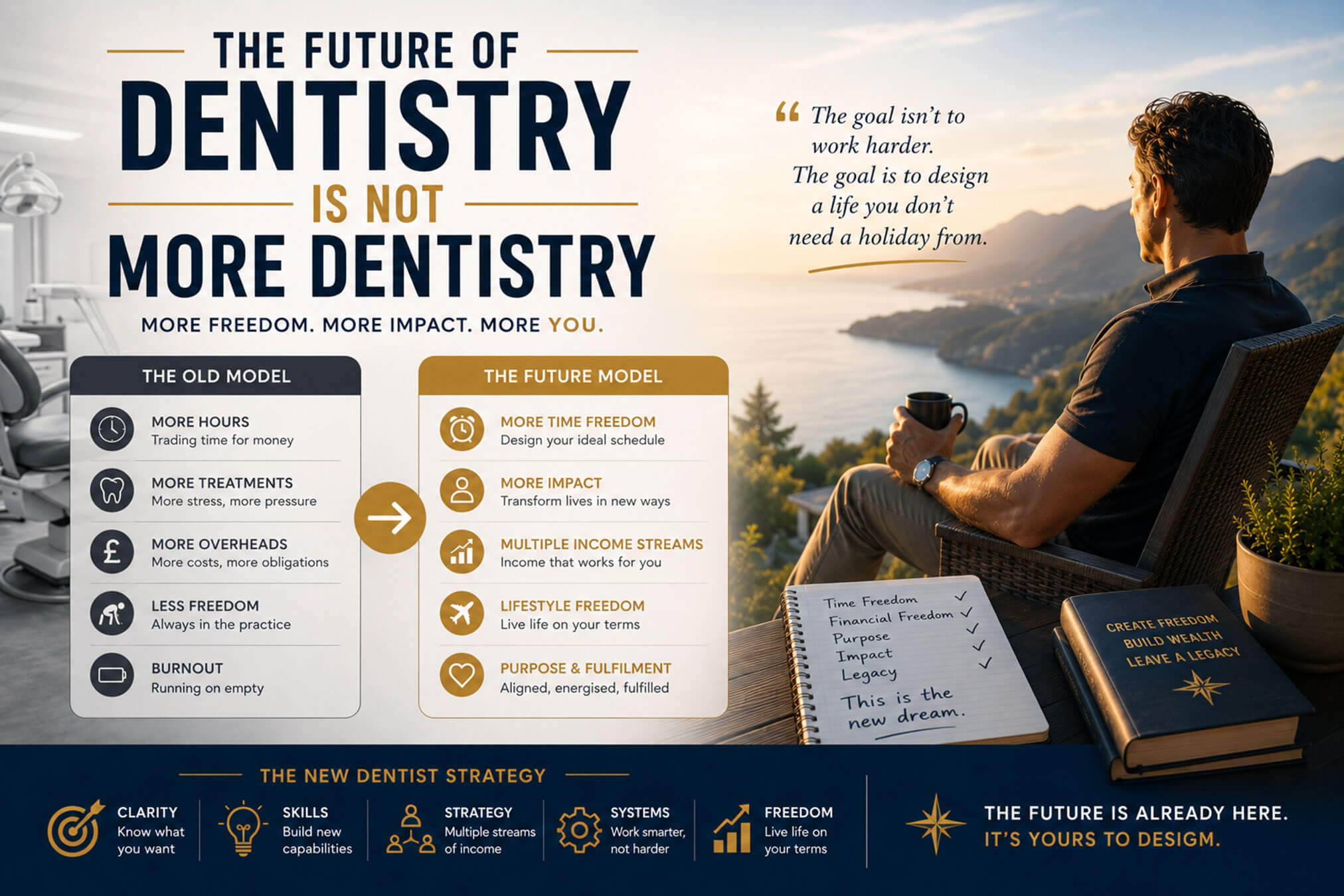
The future of dentistry is not more dentistry. It is deeper dentistry — built by practitioners who have expanded beyond the surgery to build the clinical, commercial, and personal foundations that make deeper, more meaningful clinical practice possible.
What the Data Tells Us About Timing
The statistics on NHS departure, private sector growth, and aesthetic medicine expansion are not warnings. They are directions.
Eighty-six percent of dentists intend to leave the NHS within five years. Almost a third of patients in England are already using private dentistry — a figure that has grown by almost 50% in just two years. The aesthetic medicine market is growing as an ageing population and a wellness-oriented culture drive demand for non-surgical treatments that dentists are uniquely qualified to deliver. The dental sector’s leading transactional advisors are explicitly identifying mixed-income, diversified practices as the most valuable and most sought-after acquisition targets in 2026.
These are convergences. The demand for what dentists can offer — beyond UDA-funded restorative care — is expanding. The structural case for the traditional NHS model is collapsing. The professional conditions that produce burnout and departure are intensifying. And the financial and clinical alternatives — aesthetics, property, performance reset — are more accessible, more structured, and more practically proven than they have ever been.
The dentists who act on this now are not early adopters of a speculative trend. They are prudent responders to a structural transition that the data has been telegraphing for years.
The Profession Is Being Redesigned — With or Without You
Here is the honest observation that sits underneath all of this.
The profession is changing regardless of what any individual practitioner decides. The NHS dental model is under existential pressure. Artificial intelligence and digital automation are restructuring the procedural landscape. The patient population is ageing, diversifying in its health expectations, and increasingly consumer-oriented in its approach to clinical care. The workforce is exhausted, divided, and in significant numbers actively planning its departure from the structures that once defined the profession.
The question is not whether dentistry will change. It is who shapes the change — and who is shaped by it.
The dentists who will thrive in the next decade are not those who wait for the profession to stabilise, for the contract to reform, for the NHS to find its way through. They are the ones who, right now, are expanding their clinical repertoire into aesthetics and adjacent medicine. Building financial structures that decouple their income from their physical presence. Restoring the performance foundations that allow them to pursue both with clarity and vigour.
They are, in other words, the dentists who have understood that the future of their profession is not a dental future. It is a human one. Built around the full architecture of a professional life — clinical, commercial, and personal — rather than around the narrow lane of a single NHS contract.
The Botulinum Toxin Club exists to open the clinical dimension of that future. The Dental Property Club exists to build the financial dimension. Performance Reset exists to restore the human dimension.
Together, they represent not three separate offers, but a single, coherent vision: the complete redesign of what a dental career can be, in the hands of a practitioner who is ready to build it.
The Only Irreversible Decision Is Waiting
The greatest risk available to a dentist right now is not making the wrong choice about aesthetics or property or performance. It is making no choice at all — continuing to operate within a structural model that is visibly, measurably, statistically failing to deliver the professional and financial outcomes that dentists deserve.
The Clinician Freedom Scorecard — the starting point at drharrysingh.com — is a four-minute diagnostic that identifies precisely where the highest-value first investment of energy lies for any individual practitioner. Not as a sales mechanism. As a genuine map — a starting point for the systematic, intelligent redesign of a dental career that the profession has never taught and the system has never supported.
The future of dentistry is already arriving. It is being built by dentists who decided, at some specific moment, that the old covenant was broken — and that the job of building the new one was theirs, not the NHS’s, not the GDC’s, not the profession’s.
That moment is available now.
The only question is whether you take it.
Dr Harry Singh is the founder of the Botulinum Toxin Club (botulinumtoxinclub.co.uk), the Dental Property Club (dentalpropertyclub.co.uk), and Performance Reset (performancereset.co.uk). He works privately with ambitious clinicians who are ready to elevate — clinically, commercially, and personally.
References
- Dissatisfied Dentists Plan to Leave NHS – What Next? | All Med Pro - 86% of dentists intend on leaving the NHS within the next 5 years – and almost half of those plan to...
- Lack of reform: Nearly 1/2 dentists severing ties with NHS - Nearly half (45%) report they have reduced their NHS commitment since the onset of the pandemic, by ...
- Dentists Leaving NHS in Droves - Lowest Numbers - Carter Bond - In 2019-2020, England had almost 25,000 NHS dentists, however during the last two years, the total h...
- Almost a third of people in England use private dentists amid NHS dental crisis - Exclusive: Watchdog finds sharp rise in number of poorer households forced to pay for fillings and e...
- NHS dentistry - where did it all go wrong? - The Lowdown - Despite a Select Committee condemning the dental contract as 'unfit for purpose', Rishi Sunak's clai...
- Data analysis: impact of the Dental Recovery Plan - NHS England - Finding: The Dental Recovery Plan did not increase delivery of UDAs (excluding those earned through ...
- Dental Trends UK 2025: What's Changing and Why It Matters - Discover dental trends UK shaping the future of dentistry in the UK. Learn about the latest advancem...
- Facing the future of AI - Dentistry.co.uk - Julian Perry casts a look ahead to what artificial intelligence could spell for the dental professio...
- Tech-Savvy Teeth: The Cutting-Edge Technology in Private Dentistry - Whether it's digital X-rays, laser treatments, 3D-printed crowns, or AI-assisted care, the future of...
- ADG identifies three seismic shifts impacting UK dentistry - The Probe - The Association of Dental Groups (ADG) launches a new whitepaper: ‘Futurism & Dental Dynamism: The n...
- Dental Dean Update – How Dental Care Evolved from 2000 to 2025 - The evolution in technology, education delivery, global dental health, and indeed the roles of denta...
- Dentistry is Shifting From Functional To Aesthetic and Wellbeing - Another reason dentists are adding beauty treatments is the financial opportunity. Cosmetic treatmen...
- Property investment – the ideal passive income stream in 2021 - One of the great realisations for dentists in 2020 was that their income is not as rock solid as the...
- The dental sector in 2026: What's really shaping the year ... - According to Christie & Co’s latest Business Outlook 2026 report, the dental sector is gearing up fo...
- How stress and burnout impact dental teams - General Dental Council - Workplace difficulties deeply affect our overall mental health, making it crucial for dental teams t...
- NHS England » Submission to the Review Body on Doctors' and ... - Overall, the NHS is providing more care contacts in 2024 across secondary care services, mental heal...
- Dental professionals feel they have no choice but to work when their mental health is suffering - Learn to reduce your risk with our online articles, features, case reports, guidance and resources.
- The Future Dental Practice: 2026 and Beyond (UK with a Global Lens) - Dentistry in the UK is standing at a crossroads. NHS access challenges, workforce shortages, and ris...
- How Many Dentists Have Left the NHS? 2022/23 - Cairn Technology - According to one report, at the end of 2020 there were 23,733 dentists providing NHS care in England...