
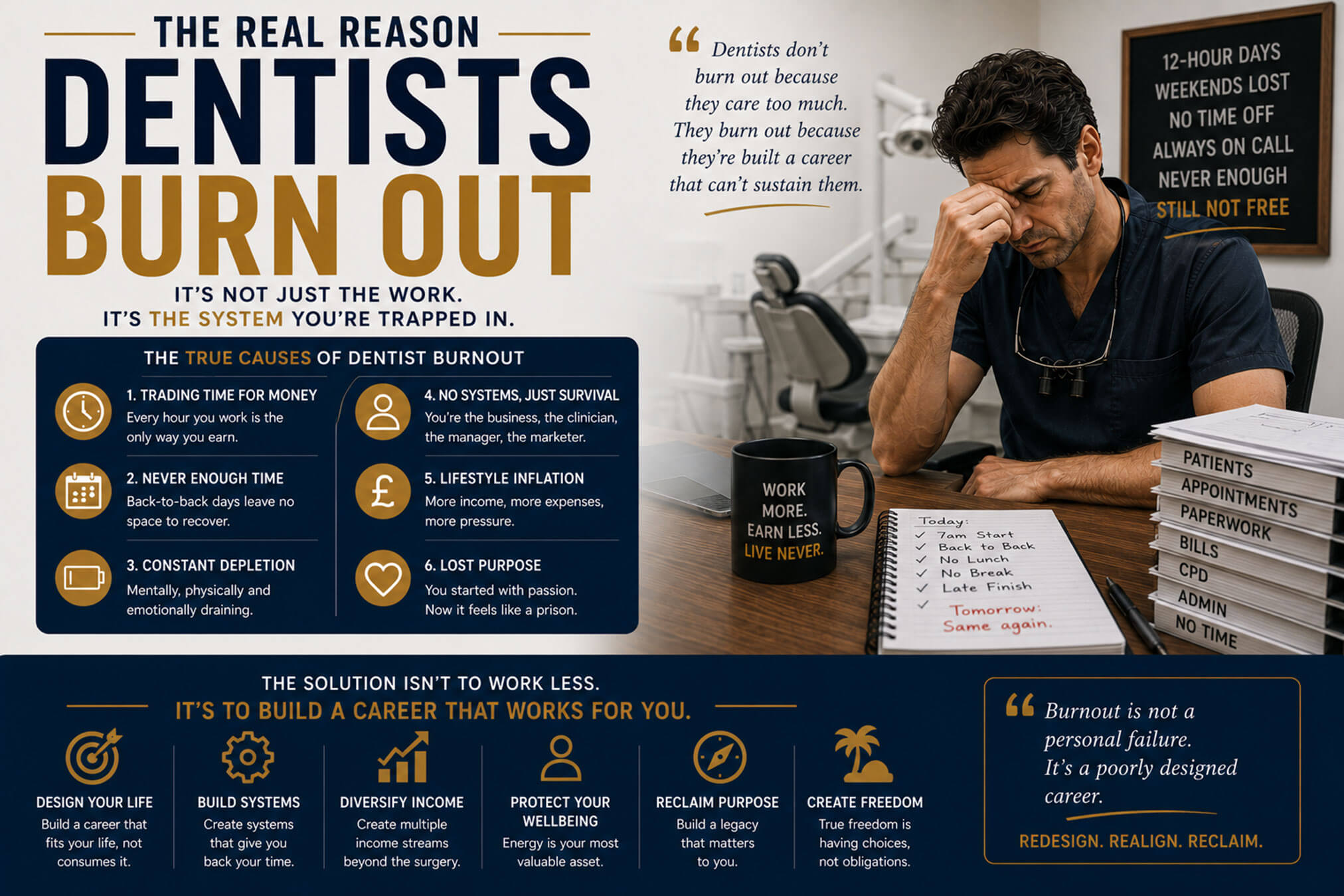
When people talk about burnout in dentistry, they usually point to the obvious things.
The NHS contract.
UDA pressure.
Admin overload.
Staff shortages.
Rising costs.
Patient expectations.
Complaint culture.
Regulatory pressure.
None of that is wrong.
But it is incomplete.
Because those are the visible pressures. They are the external expressions of a deeper problem. They explain what is happening around dentists, but not fully why so many are breaking under it.
The real reason dentists burn out is not simply that the job is hard.
It is that too many are forced to operate inside a structure that continually demands more energy than it returns — financially, emotionally, psychologically, and physically.
Burnout is not just overwork.
It is prolonged imbalance.
Burnout Is an Energy Equation
A demanding profession does not automatically create burnout.
There are many intense careers in the world. People can work hard, even very hard, without burning out — if there is enough meaning, enough autonomy, enough reward, enough recovery, and enough sense that what they are giving is producing something worthwhile in return.
Dentistry becomes dangerous when those balancing forces disappear.
When effort rises but reward becomes flatter.
When responsibility rises but autonomy shrinks.
When patient care still matters but the system around it erodes the satisfaction of delivering it.
When output remains high but replenishment becomes too weak to match it.
That is when the equation breaks.
And once it breaks for long enough, people stop feeling tired and start feeling depleted at a deeper level. Their motivation changes. Their emotional range narrows. Their tolerance shortens. Their clarity drops. Their ability to access enthusiasm becomes inconsistent. They keep functioning, often impressively, but something underneath the functioning starts to wear away
That is burnout.
Not sudden collapse.
Progressive depletion.
Effort Without Reward Is Psychologically Toxic
One of the least discussed drivers of dental burnout is effort-reward distortion.
Put simply: people can tolerate substantial effort when the effort feels proportionate to the outcome.
But in much of modern dentistry, especially where systems are rigid and volume-driven, clinicians give enormous amounts of energy without experiencing a matching return.
More effort does not always produce more income.
More skill does not always create more autonomy.
More responsibility does not always create more respect.
More commitment does not always create more freedom.
That matters far more than most people realise.
Because human beings are not drained only by effort. They are drained by effort that feels structurally trapped. Effort that seems to disappear into a machine that keeps asking for more while giving back less than it should.
A dentist can work hard and feel proud.
A dentist can work equally hard and feel used.
Those two experiences may look similar from the outside. Internally, they are entirely different. One is demanding but sustainable. The other is a direct route to emotional exhaustion.
The Physical Toll Is Part of the Burnout Story
Burnout is often spoken about as though it lives only in the mind.
That is a mistake.
Dentistry is physically punishing work. The postures, fine motor repetition, neck positioning, spinal loading, visual strain, jaw tension, shoulder elevation, and static focus required day after day create a physical environment in which depletion becomes normalised.
Many dentists live with chronic tightness, fatigue, back pain, headaches, poor sleep, low-grade inflammation, and nervous system overstimulation without fully registering how much these states are shaping their mood, focus, resilience, and judgment.
The body is not separate from burnout.
It is one of the places burnout happens.
A physically depleted clinician will not think, feel, or decide the same way as a restored one. Pain narrows tolerance. Exhaustion reduces perspective. Poor recovery lowers emotional capacity. Tension hardens reactivity. Over time, what seems like “mental burnout” is often partly physiological overload expressed psychologically
This is why simplistic advice about burnout often fails.
Because telling a burned-out dentist to “look after themselves” without addressing the actual state of their nervous system, musculoskeletal health, and cognitive fatigue is like advising someone to drive better while ignoring the fact that their engine is failing.
High Functioning Burnout Is the Most Dangerous Kind
One of the reasons dentistry has such a hidden burnout problem is that many dentists remain highly functional for a long time.
They keep showing up.
They keep performing.
They keep delivering.
They keep smiling.
They keep earning.
They keep coping.
From the outside, they look fine.
Inside, they are operating with less and less reserve.
This is high-functioning burnout, and it is arguably more dangerous than visible collapse because it is easier to ignore and easier to reward. The clinician who keeps producing despite depletion is often praised for commitment, reliability, and resilience. But if the performance is being maintained by consuming deeper and deeper internal reserves, it is not sustainable strength. It is expensive endurance.
Eventually the cost arrives.
Sometimes as emotional numbness.
Sometimes as cynicism.
Sometimes as irritability.
Sometimes as anxiety.
Sometimes as health breakdown.
Sometimes as a growing fantasy of escape that becomes harder and harder to dismiss.
The outward competence can continue long after the inward wellbeing has started to fracture.
That is why many dentists do not recognise burnout early. They assume that because they are still functioning, the problem cannot be serious.
In reality, functioning can be the disguise.
The System Often Punishes Recovery
Another reason burnout becomes so entrenched is that many dentists do not work in systems that reward recovery.
Time off can feel expensive. Slowing down can feel irresponsible. Reducing output can feel financially threatening. Asking for help can feel risky. Admitting depletion can feel professionally embarrassing. Many clinicians are surrounded by a culture that normalises coping and quietly stigmatises vulnerability.
So instead of recovery, they reach for adaptation.
More caffeine.
Shorter breaks.
Pushing through.
Numbing out.
Working faster.
Thinking less deeply.
Hoping a holiday will fix a structural problem it was never designed to solve.
But recovery cannot be improvised at the edge of exhaustion. It has to be designed.
This is where many professionals get trapped in a false binary: either keep going as you are, or break down completely.
In reality, there is a third path.
A deliberate reset.
Not indulgence.
Not weakness.
Not escape.
A reset in the truest sense: restoring the body, calming the nervous system, widening cognitive bandwidth, and rebuilding the internal conditions required for sustainable performance
Burnout Is Also a Freedom Problem
There is another layer to this that matters enormously.
Many dentists are not just burned out by the work itself. They are burned out by the feeling of having no alternative.
When income depends entirely on clinical output, work becomes heavier. When the body is tired but the structure demands continued production, fatigue becomes more frightening. When a clinician knows they need space but feels financially unable to create it, stress intensifies.
This is why burnout is so often linked to freedom.
Not in a vague motivational sense, but in a structural one.
A dentist with one income stream, no leverage, no asset growth, and no strategic optionality experiences pressure differently from one who has begun to build alternative sources of value, income, or control. The workload may look similar on paper, but psychologically it is not the same experience.
The person with options feels strain.
The person without options feels entrapment.
Entrapment accelerates burnout.
And once that is understood, it becomes clear why performance reset, wealth strategy, and career redesign are not separate conversations. They are connected. Deeply.
The Real Solution Is Not Just “Less Stress”
Most conversations about burnout aim too low.
They focus on stress reduction rather than structural redesign.
But the real solution is not merely to help dentists cope slightly better with an unsustainable setup. The real solution is to rebuild the conditions under which they work and live
That means restoring physical capacity.
Regulating the nervous system.
Improving sleep and energy.
Reclaiming mental clarity.
Creating stronger financial architecture.
Expanding identity beyond one exhausted model of work.
Building income and opportunity in ways that reduce total dependence on the chair.
The dentists who build freedom outside the surgery are not a different breed. They are dentists who understood, at a specific moment, that their highest contribution to clinical practice was not to confine themselves to it — but to build the complete professional architecture that would let them bring their best clinical self, freely and deliberately, to every patient they choose to treat.
In other words, the answer is not just rest.
It is redesign.
Because burnout is not merely a personal failure of endurance. It is often the perfectly logical consequence of a professional model that has become too narrow, too extractive, and too depleted to sustain the people inside it.
The Better Diagnosis
The question is not:
Why can’t dentists cope better?
The better question is:
Why are so many dentists expected to keep giving more than their current structure can healthily return?
That is the real question.
And once that question is asked honestly, the path forward changes.
Burnout stops being something to hide.
It becomes something to understand.
And once it is understood, it can be interrupted.
Not with slogans.
Not with surface-level self-care.
But with the kind of strategic reset that gives the clinician their energy, clarity, and options back.
That is where recovery becomes real.
Dr Harry Singh is the founder of the Botulinum Toxin Club (botulinumtoxinclub.co.uk), the Dental Property Club (dentalpropertyclub.co.uk), and Performance Reset (performancereset.co.uk).
References
- Flow state and peak performance - Zevo Health - This article explores flow state and how it has such a positive impact on performance and wellbeing ...
- The Psychology of High Performers: Understanding the Elite Mindset - They don't just believe in their ability to improve; they actively seek out challenges that push the...
- Development and validation of a flow state scale for healthcare ... - The flow state is referred to by various terms—such as optimal performance, peak experience, and wor...
- If I stop, who am I? Identity shifts for high performers who are tired of ... - Identity shifts can feel tender at first, especially for high performers who are used to being stron...
- Dentistry is Shifting From Functional To Aesthetic and Wellbeing - Another reason dentists are adding beauty treatments is the financial opportunity. Cosmetic treatmen...
- Multiple Streams of Income for Doctors - The White Coat Investor - Just as diversification in your portfolio is valuable, so is receiving income from uncorrelated, mul...
- Property investment – the ideal passive income stream in 2021 - One of the great realisations for dentists in 2020 was that their income is not as rock solid as the...
- Is passive income possible for dentists? | Dr. Ingrid Murra - LinkedIn - Is passive income possible for dentists? The answer is yes. Here's how to build revenue streams that...
- How stress and burnout impact dental teams - General Dental Council - Workplace difficulties deeply affect our overall mental health, making it crucial for dental teams t...
- NHS England » Submission to the Review Body on Doctors' and ... - Overall, the NHS is providing more care contacts in 2024 across secondary care services, mental heal...