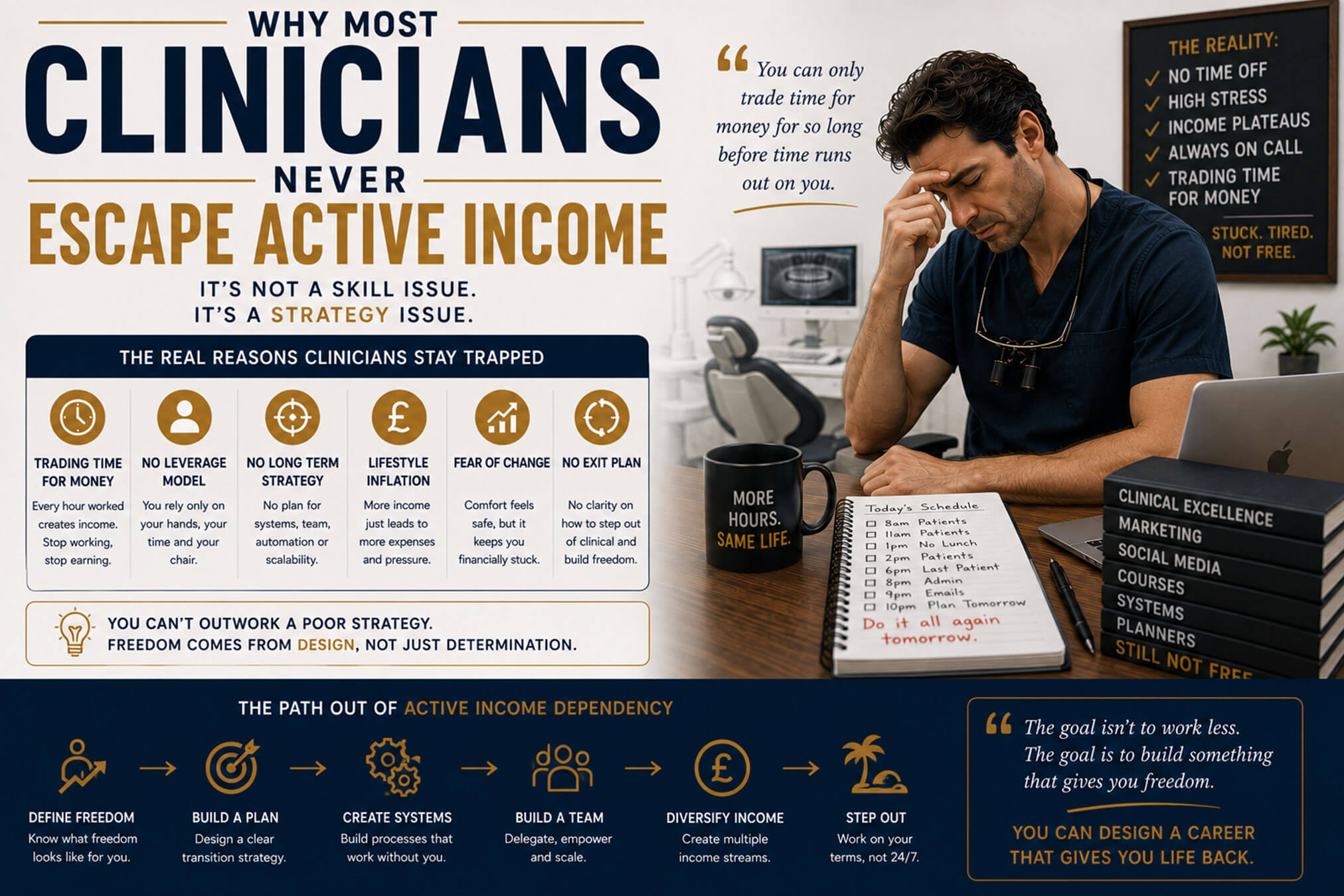
Most dentists know, at least intellectually, that depending entirely on clinical income is not a sound long term financial strategy.
Most have heard that passive income matters. Most know that property can create options. Most understand that facial aesthetics can generate stronger margins. Most have sensed, at some point, that there must be a better model than working harder inside a system that never fully gives back what it takes.
And yet most do nothing.
Not because they lack intelligence. Not because they are lazy. Not because the information is unavailable.
They stay where they are because a set of psychological and structural forces quietly keeps them there. These forces are subtle enough to feel normal, powerful enough to shape an entire career, and familiar enough that they are rarely questioned. Until someone names them, they simply feel like life.
And that is precisely why so many clinicians never escape active income.
Force One: The Urgency of Now
Clinical life is built around immediacy.
Patients are booked in. Treatment plans need completing. Staff have questions. Notes need finishing. Complaints need managing. Equipment needs sorting. Family needs attention. Tax deadlines arrive. CPD stacks up. Every day presents something concrete, immediate, and undeniably real.
The problem is not that these things matter. The problem is that they matter now.
And when life is dominated by what matters now, what matters most over the long term is repeatedly postponed. Not rejected. Postponed. Quietly. Respectably. Repeatedly.
This is one of the most common traps in professional life. It sounds intelligent when it speaks. “I’ll look into property when things settle down.” “I’ll do the aesthetics training once this month is over.” “I’ll sort my financial structure when I have more space.” “I’ll think about my energy when work gets less intense.”
But things do not settle down on their own. Space is not found. It is made. And what gets postponed in a demanding career is usually not the unimportant thing. It is the strategic thing.
So the years move. The clinical income continues. The intention remains intact. But the architecture never changes.
Force Two: Identity Capture
There is another reason clinicians stay trapped, and it runs deeper than scheduling.
Many dentists do not just work clinically. They are clinicians in the deepest sense of identity. Their self worth, credibility, and sense of purpose are tied to being excellent in surgery, reliable under pressure, and professionally respected by peers and patients alike.
There is dignity in that. There is real meaning in that
But there is also a risk.
When identity becomes too tightly fused to one professional role, anything outside that role can feel disloyal, unnecessary, or vaguely indulgent. Property starts to feel “not really what I do.” Business building feels like distraction. Aesthetics feels like departure. Performance coaching feels self-involved. Even when these moves are sensible, strategic, and potentially life-changing, they can feel psychologically difficult because they challenge the story a clinician has told themselves for years.
This is what can be called identity capture: when a person becomes so fully defined by one domain of competence that they struggle to expand into another, even when expansion is exactly what freedom requires.
It is not lack of ability. It is lack of permission.
Force Three: The Knowledge Gap
There is also a far simpler reason that many clinicians never escape active income:
They genuinely do not know how.
Dental school teaches anatomy, treatment planning, pathology, ethics, pharmacology, patient management, and technical execution. It does not teach wealth strategy. It does not teach leverage. It does not teach passive income frameworks. It does not teach property acquisition. It does not teach brand architecture, commercial systems, content ecosystems, or scalable offers.
So when a dentist begins to suspect they need a different model, they do not just face a decision. They face a second education.
And second educations are intimidating
There is new vocabulary. New risks. New rules. New uncertainty. New communities where you do not yet feel fluent. The clinician who is highly competent in one room suddenly feels inexperienced in another.That experience alone is enough to make many people retreat to the environment where they already know how to win.
Which is why so many remain in the surgery, not because they believe it is the full answer, but because it is the domain in which they still feel certain.
The knowledge gap is expensive not only because it limits options, but because it preserves dependency by making every alternative feel more complex than it needs to be.
Force Four: The Perfectionism Trap
High-performing clinicians are rarely impulsive. That is one of their strengths.
But in the context of financial freedom, that strength often mutates into a trap.
Dentists are trained in a world where precision matters, mistakes have consequences, and risk must be carefully managed. They are rewarded for preparation, caution, and exactness. Those habits are appropriate in clinical settings.
But outside the surgery, especially in investment, business, and career design, they can become paralysing.
The perfectionism trap sounds like prudence. “I just need to do a bit more research.” “I want to be sure before I commit.” “I’m waiting until the timing is right.” “I want to understand every angle.”
Again, these statements sound intelligent. Often they are intelligent.
But if used repeatedly, they become a sophisticated form of avoidance.
Because the truth is that wealth-building decisions are not made in perfect certainty. They are made with incomplete information, managed risk, and enough confidence to take the first step before full clarity arrives. The clinician waiting for certainty is often waiting for something the real world does not offer.
So nothing happens. Not because action is impossible. Because the standard for action has been set unrealistically high.
Why Good Intentions Are Not Enough
It is worth stating plainly that most clinicians are not trapped because they lack ambition.
In fact, many are highly motivated. They want a better life. They want more control. They want financial resilience. They want optionality. They want to feel that the effort they have invested into becoming exceptional actually leads somewhere beyond survival, bills, and burnout.
But intention without structure changes nothing.
If urgency keeps winning, identity stays narrow, the knowledge gap remains unclosed, and perfectionism prevents movement, then even the best intentions will simply become recurring thoughts in an unchanged career.
Meaning to start.
Meaning to diversify.
Meaning to invest.
Meaning to reset.
Meaning to stop relying on one source of income.
Meaning to create options.
Meaning to is not meaningless. But it is not movement.
What Actually Creates the Exit
Escaping active income is not one decision. It is the removal of friction.
It begins by recognising that the problem is not just financial. It is behavioural, psychological, structural, and professional all at once
The urgency problem is solved by allocating protected time for strategic action before life “allows” it.
The identity problem is solved by expanding self-concept — from dentist only to clinician, investor, educator, entrepreneur, leader.
The knowledge problem is solved by entering environments where the path is structured and the learning curve is shortened.
The perfectionism problem is solved by taking a contained first step rather than waiting for absolute certainty
This is why the right ecosystem matters. Not because people need motivation in the abstract, but because they need frameworks that reduce friction and make intelligent action easier than endless hesitation.
That is what systems like the Botulinum Toxin Club, the Dental Property Club, and Performance Reset are really doing beneath the surface. They are not just offering information. They are solving the forces that keep clinicians stuck.
The Escape Is Simpler Than It Feels
The phrase “escape active income” can sound dramatic, but in practice it usually begins with surprisingly modest moves.
One course.
One better income stream.
One investment decision.
One protected morning a week.
One conversation with the right community.
One physical reset that restores the energy to think properly again.
One new identity that allows a clinician to stop imagining themselves only inside the surgery.
That is how bigger change begins.
Not with a radical reinvention all at once, but with a deliberate break from the forces that have kept life structurally the same.
Most clinicians do not escape active income because they never interrupt the pattern strongly enough to start building something else.
But once the pattern is seen clearly, it becomes much harder to remain loyal to it.
And that is where freedom begins.
Dr Harry Singh is the founder of the Botulinum Toxin Club (botulinumtoxinclub.co.uk), the Dental Property Club (dentalpropertyclub.co.uk), and Performance Reset (performancereset.co.uk).
References
- Flow state and peak performance - Zevo Health - This article explores flow state and how it has such a positive impact on performance and wellbeing ...
- The Psychology of High Performers: Understanding the Elite Mindset - They don't just believe in their ability to improve; they actively seek out challenges that push the...
- Development and validation of a flow state scale for healthcare ... - The flow state is referred to by various terms—such as optimal performance, peak experience, and wor...
- If I stop, who am I? Identity shifts for high performers who are tired of ... - Identity shifts can feel tender at first, especially for high performers who are used to being stron...
- Dentistry is Shifting From Functional To Aesthetic and Wellbeing - Another reason dentists are adding beauty treatments is the financial opportunity. Cosmetic treatmen...
- Multiple Streams of Income for Doctors - The White Coat Investor - Just as diversification in your portfolio is valuable, so is receiving income from uncorrelated, mul...
- Property investment – the ideal passive income stream in 2021 - One of the great realisations for dentists in 2020 was that their income is not as rock solid as the...
- Is passive income possible for dentists? | Dr. Ingrid Murra - LinkedIn - Is passive income possible for dentists? The answer is yes. Here's how to build revenue streams that...
- How stress and burnout impact dental teams - General Dental Council - Workplace difficulties deeply affect our overall mental health, making it crucial for dental teams t...
- NHS England » Submission to the Review Body on Doctors' and ... - Overall, the NHS is providing more care contacts in 2024 across secondary care services, mental heal...