
Why Most Dentists Never Reach the Top
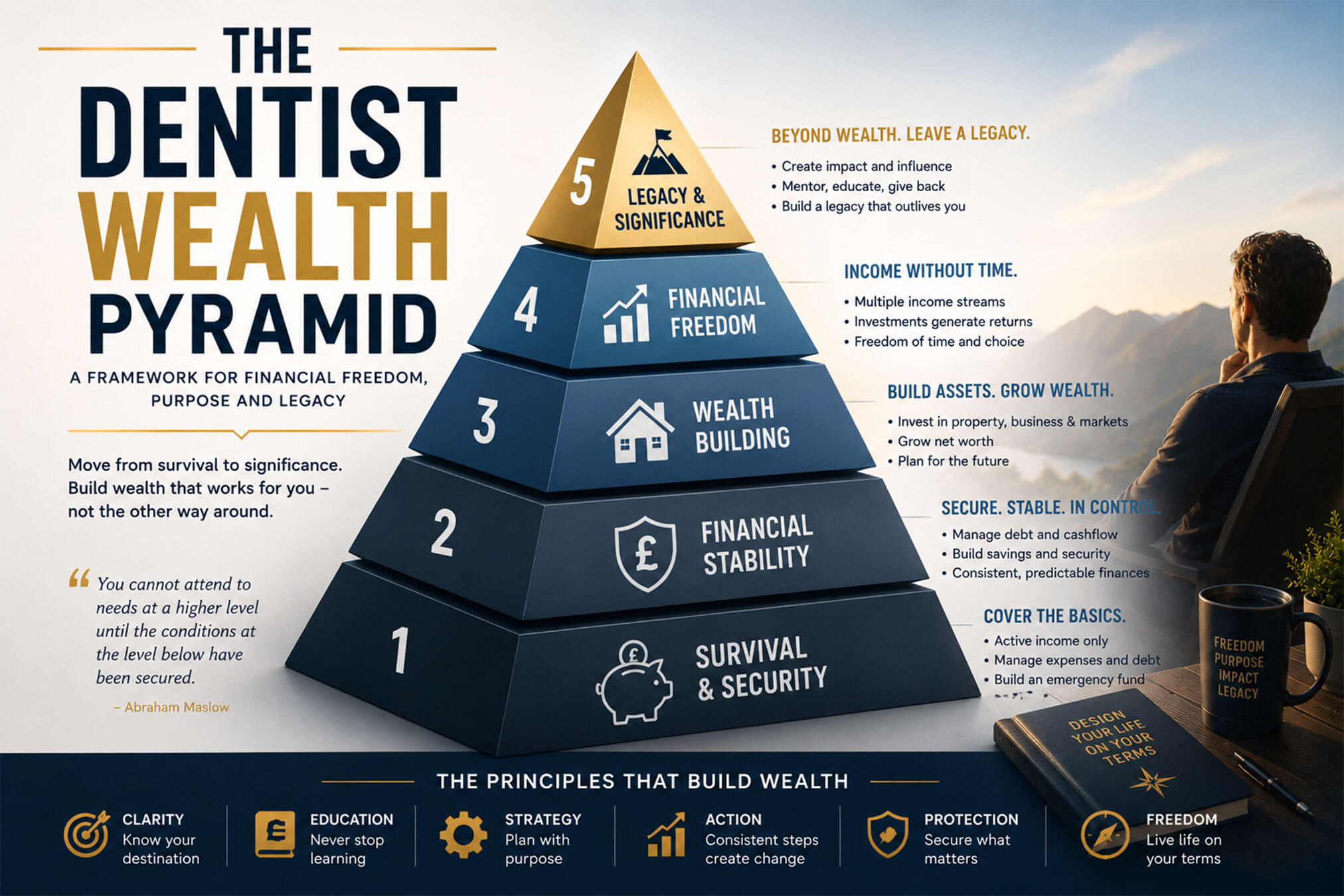
There is a framework, familiar to anyone who has studied psychology, that describes how human needs are structured — not as a flat list, but as a hierarchy. Maslow’s pyramid places survival at the base and self-actualisation at the peak. The principle is elegant and profoundly practical: you cannot attend to needs at a higher level until the conditions at the level below have been secured. Hunger crowds out creativity. Financial terror crowds out purpose.
What Maslow observed about human motivation applies, with extraordinary precision, to the financial lives of dental professionals.
Most dentists spend their entire careers on the lower levels of what might be called the Dentist Wealth Pyramid — not because they lack intelligence, ambition, or earning power, but because no one has ever shown them the structure of the pyramid itself. They move through their professional lives building income, managing debt, growing a patient list — without a framework that tells them where they currently are, where they need to go next, and what the journey between those two points actually looks like.
This article is that framework.
The Dentist Wealth Pyramid is a five-level model of financial progression, built specifically around the economic realities, professional context, and psychological dynamics of UK dental professionals. Each level represents a distinct financial condition — with its own pressures, its own constraints, and its own specific requirements for advancement. Moving up the pyramid is not a matter of earning more. It is a matter of building differently.
Understanding the structure is the precondition of everything else.
Level One: Survival — The Foundation Layer
The pyramid begins where most dental careers begin: in debt.
The average dental graduate in the UK now carries student loan debt of approximately £52,922 — more than double the figure from just a decade ago. For self-funded students who attended private dental school, loan balances of £100,000 are now commonplace. A 9% graduate loan repayment is deducted from income above the threshold from day one of clinical practice. National Insurance contributions begin immediately. Income tax applies from the first pound earned above the personal allowance.
The financial condition of the newly qualified dentist is, in structural terms, a deficit position. More is owed than is owned. Income is real, but obligations immediately consume much of it. The psychological experience of this condition is one of managed urgency — the sense that every financial move is reactive rather than deliberate, that the income being generated is being distributed to creditors before the practitioner has any meaningful opportunity to deploy it strategically.
This is Level One: Survival.
It is characterised by three specific financial realities:
Active income only. Every pound that comes in is the direct product of clinical hours. Nothing generates return during time off, illness, or leave.
High fixed obligations relative to income. Student debt, professional insurance, GDC fees, CPD costs, and the basic cost of living consume a disproportionate percentage of early-career income, leaving minimal surplus for saving or investing.
Zero financial buffer. Without an emergency fund — which most graduates do not have — a single disruption (illness, practice closure, equipment failure) creates immediate financial crisis.
The danger of Level One is not that it is uncomfortable. The danger is that its structure, if not consciously identified and addressed, has a powerful tendency to persist well beyond the graduate years. The obligations accumulate additional texture — a mortgage, a family, a car, a lifestyle — without the underlying architecture ever changing. A dentist in their forties with a full appointment book can still, in structural terms, be living at Level One: active income only, high obligations, no buffer, no assets generating independent returns.
The exit from Level One requires one specific move: protecting the income that has been worked so hard to generate. Income protection insurance. Emergency fund. The construction of a financial floor beneath which consequences cannot fall catastrophically. This is not glamorous wealth-building. It is the foundational step without which no higher level is securely accessible.
Level Two: Stability — The Platform You Don't Know You're On
Level Two is the most populated level on the Dentist Wealth Pyramid. It is also the most dangerous — not because it is uncomfortable, but because it is comfortable enough to mistake for progress when it is, in fact, a plateau.
At Level Two, the immediate financial pressures of Level One have eased. Student debt, while still present, is being serviced rather than threatening. Income has grown through experience, associates, or a move toward more private provision. The mortgage is in place. The family is provided for. The professional obligations are being met.
By almost every external measure, the dentist at Level Two is doing well. And this external validation — the nice house, the decent car, the respected position in the community — creates a powerful cognitive illusion: the sense that financial progress is being made, when what is actually happening is that financial obligations have simply been upgraded to match the improved income.
This is lifestyle inflation completing its invisible work. As income has risen, expenditure has risen to meet it — or exceeded it. The fixed cost base of the dentist’s life is now substantial: mortgage, school fees perhaps, the car on finance, the holidays, the restaurant dinners that feel earned and are. Each of these choices was individually reasonable. Collectively, they have produced a situation in which income is strong but wealth — assets that generate independent returns — is minimal.
Research consistently demonstrates that roughly a third of individuals earning what would be considered high incomes still live financially paycheck-to-paycheck. Among dental professionals, the pattern is particularly pronounced: high income, high expenditure, modest net worth. The dentist at Level Two earns well but owns little — and the gap between earning and owning is the gap between stability and freedom.
The critical financial insight about Level Two is this: income is not wealth. Income is a flow. Wealth is a stock — accumulated assets that exist independently of whether you are working, and that generate returns whether you are in the surgery or not. A dentist with £150,000 annual income and no assets is not wealthier than a dentist with £100,000 annual income and a property portfolio generating £30,000 passive income per year. The second dentist is building a structure. The first is running a treadmill at higher speed.
The exit from Level Two requires the recognition of a specific problem — not insufficient income, but insufficient conversion of income into assets — and the construction of a first investment structure that begins to produce returns independent of clinical hours.
This is where the Dental Property Club framework becomes directly relevant. Not as a retirement strategy, but as the first concrete step from a stability that feels like progress into a foundation that actually is.
Level Three: Expansion — Where the Architecture Begins
Level Three is where the Dentist Wealth Pyramid changes character. Below it, the focus was defensive: protect income, manage debt, build stability. At Level Three, the orientation shifts from protection to construction.
The dentist at Level Three has secured the base: income is stable, obligations are manageable, a financial buffer exists. Now, for the first time, there is genuine surplus — not just income exceeding obligations, but discretionary capacity that can be deployed into wealth-building structures rather than consumed by lifestyle costs.
There are two primary construction projects at Level Three, and they work most powerfully in parallel.
Clinical expansion into higher-value income. The first project is the transformation of the income profile — from NHS-capped, procedure-volume-dependent income to income that is more responsive to expertise and more generously rewarded per unit of clinical time.
Facial aesthetics — through the Botulinum Toxin Club — is the most direct vehicle for this transformation available to dental professionals. The anatomy is already known. The clinical precision is already developed. The patient trust is already established. What the BTC Launchpad Programme adds is the technical mastery, the commercial framework, and the consultation architecture that converts those existing assets into a genuinely different income proposition — one where a single aesthetic session generates more revenue than a full NHS list.
The Singh’s Success System built into the BTC curriculum is designed to generate £5,000 in additional revenue within 90 days of completing training — not through aggressive marketing, but through the intelligent activation of relationships and expertise that already exist. The market is already there. The UK aesthetics sector is worth over £3 billion annually and is growing. The dentist who enters this market with genuine clinical credibility and structured commercial knowledge is not competing with weekend-trained aestheticians. They are operating in a different league.
Asset accumulation outside the surgery. The second construction project at Level Three is the systematic deployment of surplus income into appreciating assets. Property investment — structured and mentored through the Dental Property Club — is the most accessible and most structurally appropriate starting point. The first acquisition is typically modest. Its primary purpose is not to generate transformative passive income immediately. It is to initiate the architecture — to build the first structure outside the surgery that generates returns independent of clinical presence.
The psychological significance of this first asset is disproportionate to its financial scale. It represents, concretely and tangibly, the beginning of the transition from active-income-only to a multi-stream financial architecture. The dentist who has made their first property investment has made a decision that the surgery is not the only theatre in which their financial life will be played out. That decision — once made — compounds.
Level Three is characterised by expanding income, initial asset formation, and the first emergence of genuine financial optionality. The compounding has begun. The direction is set. But the position is not yet secure, and the most critical risk at this level is not financial — it is operational.
The dentist expanding their clinical scope through aesthetics, managing a first property acquisition, and sustaining a full clinical caseload is running at significantly higher cognitive and physical demand than their Level Two counterpart. Without deliberate capacity management — without the performance foundations that Performance Reset is designed to build — this expansion produces diminishing returns. More activity, less clarity. More income, less quality in the decisions being made about it.
Level Three demands the full performance capacity of the professional who is navigating it. It demands clarity of judgment, physical resilience, and cognitive bandwidth. These are not automatically available. They are built, deliberately, through the kind of structured recalibration that most high-achievers defer until they cannot.
Level Four: Independence — Where Work Becomes a Choice
Level Four represents the inflection point. The structural transformation that Levels One through Three have been building toward.
At Level Four, passive income — from property, from aesthetic business, from investments — has grown to the point where it meaningfully supplements, and in some cases matches, active clinical income. This does not mean the dentist stops working. In most cases, they continue to practice — often with greater enthusiasm and depth than at any previous point in their career. But the compulsion has gone. The financial necessity of the appointment book has been removed, or significantly reduced.
The five levels of financial wealth, as described in research on financial independence, mark Level Four as the point of moderate financial independence — where assets generate passive income sufficient to cover meaningful portions of lifestyle expenses, allowing the practitioner to reduce active work while maintaining their standard of living. This is the level at which work transitions from an obligation to an expression. Where clinical excellence ceases to be something performed under financial pressure and becomes something pursued for its own sake.
Research in performance psychology consistently identifies that intrinsically motivated performance — work done for inherent satisfaction rather than financial compulsion — produces qualitatively superior outcomes to extrinsically motivated performance. The dentist who practises from choice is not the same clinician as the dentist who practises from necessity. They are more present, more generous with their time, more creative in their treatment planning, more willing to invest in their own development. The freedom that Level Four creates does not produce clinical disengagement. It produces clinical renaissance.
The financial architecture of Level Four typically involves three or more income streams operating in parallel:
Aesthetic medicine revenue generating income per appointment that substantially exceeds the NHS equivalent, with ongoing patient relationships that produce recurring treatment cycles.
Property portfolio income — rental yields from multiple properties, with equity that has compounded through capital growth across multiple years.
Clinical dental income — now positioned, whether NHS or private, as one component of a diversified financial structure rather than its sole load-bearing pillar.
The dentist at Level Four is, by almost any conventional definition, financially secure. But the characteristic that distinguishes this level from mere affluence is not the amount of income. It is the structural independence of that income from clinical presence. The portfolio generates returns whether the dentist is in the surgery on Monday morning or at a training event in Portugal. That independence is the financial expression of what Clinical Freedom actually means in practice.
Level Five: Legacy — The Peak of the Pyramid
At the apex of the Dentist Wealth Pyramid sits a level that relatively few dental professionals reach, and that fewer still consciously design for. Level Five is not characterised simply by more wealth, or by the complete cessation of work. It is characterised by the capacity to build beyond the self — to create value that extends beyond personal financial security into something more durable, more meaningful, and more broadly significant.
Level Five is what the financial freedom literature calls escape velocity — the point at which assets generate passive income in excess of all lifestyle expenses, making further active income accumulation structurally unnecessary. The financial machine, once built, runs without requiring the operator to keep feeding it.
At this level, the defining financial activities are not accumulation and protection but deployment and legacy. How is wealth deployed to create further value? What structures are built that will continue generating benefit after the individual practitioner is no longer clinically active? What knowledge, expertise, and experience accumulated over a career is shared, taught, and transmitted to the profession at large?
This is where the role of clinician-educator becomes central. The dentist who has navigated the full pyramid — who has moved from survival to stability, through expansion and into independence — possesses something of profound value to every dental professional still on the lower levels: direct, experiential, traceable knowledge of what the path actually looks like from the inside. That knowledge, once codified and shared — through training programmes, mentorship, educational platforms — produces returns that are simultaneously financial and professional. It monetises expertise while elevating the profession.
The Botulinum Toxin Club, the Dental Property Club, and Performance Reset are, in a meaningful sense, Level Five institutions — built by a practitioner who reached the apex of the pyramid and decided that the most valuable thing to do with that position was to help others reach it more efficiently, with less wasted time, fewer costly mistakes, and greater clarity about the path ahead.
This is the full expression of what dental professionals are capable of, and what the profession could look like if the structural knowledge of the Dentist Wealth Pyramid were as widely distributed as clinical technique.
Where Are You on the Pyramid Right Now?
The Dentist Wealth Pyramid is not a motivational poster. It is a diagnostic tool. Its value lies not in the aspiration it represents but in the precision it enables — the capacity to identify, honestly and accurately, your current financial position, and to determine what the specific, high-value next move looks like from exactly where you are.
Most dentists, when they encounter this framework for the first time, discover they are at Level Two. Stable, apparently comfortable, running at high clinical output — but without meaningful assets outside the surgery, without passive income, without the financial architecture that would make their clinical practice genuinely optional.
Some are at Level One — more recent graduates, or dentists who have allowed lifestyle commitments to outpace financial construction, or practitioners whose professional success has been consistently undermined by the absence of a financial floor.
A smaller number are at Level Three — in the middle of expansion, adding aesthetic income, making first property investments, but navigating the complexity and cognitive demand of building multiple income streams simultaneously, often without sufficient performance capacity to do so at the quality those decisions deserve.
Wherever you are, the next level is accessible. Not through a single dramatic transformation, but through the identification of the specific constraint that is currently most limiting your progression — and the application of the specific, proven resource that addresses it.
At Level One: Begin with the Clinician Freedom Scorecard at drharrysingh.com. Understand the structural picture. Start building the financial floor.
At Level Two: The priority is asset initiation. First contact with the Dental Property Club. First conversation about what a first acquisition looks like from your specific financial position.
At Level Three: The priority is expansion quality and performance capacity. The Botulinum Toxin Club for clinical revenue transformation. Performance Reset for the cognitive and physiological infrastructure that sustainable expansion requires.
At Level Four: The priority is consolidation and acceleration — building the passive income architecture to a scale that makes clinical practice genuinely optional, not just theoretically possible.
At Level Five: The priority is contribution — sharing the framework, educating the profession, building the platforms that help other dentists navigate the pyramid that you have already climbed.
The Pyramid Does Not Build Itself
There is one final observation that needs to be made about the Dentist Wealth Pyramid — and it is the most important one.
The pyramid does not build itself. It is not built by time, by clinical excellence, or by the accumulation of NHS activity units. It is not the natural outcome of a successful dental career, left to unfold on its own terms. It is built deliberately, by practitioners who understand its structure, who identify their current position with honesty, and who take the specific actions required to move up it — not eventually, not when the time is right, but now, with the resources and the guidance available to them.
Dentists have high incomes and valuable practices, but typically start their professional lives playing financial catch-up. The catch-up continues for as long as it takes to build the structure that replaces it. Every year that passes at Level Two without initiating Level Three construction is a year of compounding foregone — a year in which the passive income that should have been building was instead absorbed by obligations and lifestyle costs.
The pyramid framework does not exist to make you feel behind. It exists to make the path visible. And visible paths can be walked.
The Clinician Freedom Scorecard is the starting point. It maps where you are. It identifies the highest-value next step. It removes the paralysis of not knowing where to begin.
The pyramid is yours to build. The architecture is here. The only remaining variable is the decision to start.
Dr Harry Singh is the founder of the Botulinum Toxin Club (botulinumtoxinclub.co.uk), the Dental Property Club (dentalpropertyclub.co.uk), and Performance Reset (performancereset.co.uk). He works privately with ambitious clinicians who are ready to elevate — clinically, commercially, and personally.
References
- Maslow's Hierarchy of Needs - Simply Psychology - Maslow’s Hierarchy of Needs is a motivational theory in psychology proposed by Abraham Maslow. It or...
- Student debt – where are we? - The Probe - ... debt saddled at the feet of the average final year dental student and recent graduate sat at £52...
- Are dental graduates being crippled with student debt? - LinkedIn - Perhaps the most staggering is the amount of debt new graduates are facing, where student loans of a...
- Are dental graduates being crippled with student debt? - Dentistry - The amount of debt new graduates are facing, where student loans of around £100k are now commonplace...
- Among America's swelling ranks of moderate millionaires, few have ... - ... dentists. dentist finance, dentist investing, investing for dentists, dentist wealth building, d...
- Passive Wealth Accumulation in Dentistry - Dentistry uniquely combines science, service, and financial opportunity. Although it stands among th...
- FOCUS ON: Financial Survival Guide for Dentists - Dentistry Today - A: The most important factor is managing the interest rate. It's essential to create a repayment pla...
- What is Your Financial Pyramid? — Commonwealth Financial Group - You may have learned about Maslow’s Hierarchy of Needs in your high school or college psychology cla...
- Lifestyle Inflation: The High Blood Pressure of Money - Lifestyle inflation, otherwise known as lifestyle creep. It is the idea that as your income increase...
- Money Well Spent: How Dentists Can Buy Happiness - Part 2 - Many dentists experience stress from debt, high overhead, and lifestyle creep, which erodes both fin...
- Wealth accumulation for dentists: How to build financial ... - Focusing on practice profitability, strategic debt management, and disciplined savings, dentists can...
- The 5 Levels of Financial Wealth: A Framework for Success - LinkedIn - There are five clear and distinct levels of Financial Wealth: Level 1: Baseline needs are met, inclu...
- Dentistry is Shifting From Functional To Aesthetic and Wellbeing - Another reason dentists are adding beauty treatments is the financial opportunity. Cosmetic treatmen...
- Property investment – the ideal passive income stream in 2021 - One of the great realisations for dentists in 2020 was that their income is not as rock solid as the...
- Flow state and peak performance - Zevo Health - This article explores flow state and how it has such a positive impact on performance and wellbeing ...
- The Psychology of High Performers: Understanding the Elite Mindset - They don't just believe in their ability to improve; they actively seek out challenges that push the...
- 5 Levels of Financial Wealth: Mastering Income, Expenses, and ... - And level 5, complete financial freedom. All pleasures are available. Your assets generate income ex...
- Dentists have high incomes and valuable practices but start their ... - Dentists have high incomes and valuable practices but start their professional lives playing financi...