The Profession Nobody Warned You About
You were trained to save teeth, restore function, protect smiles. You trained for years — years of sitting exams, refining technique, absorbing anatomy — all in service of a profession you believed would reward your commitment. And in many ways it has. You are skilled. You are trusted. You are, by almost every conventional measure, successful.
But somewhere between the UDA targets, the GDC obligations, the insurance premiums, the rising overheads, and the patients who want more for less, a question began forming quietly at the back of your mind.
Is this it?
That question is not a sign of ingratitude. It is not weakness. It is, in fact, the most important clinical observation you will ever make — because it is a diagnosis. And like all good diagnoses, it demands not just a name but a pathway to resolution.
The data confirms what you already feel. Some 63% of dental professionals report being frequently burnt out and exhausted. More than half — 56% — have continued working through deteriorating mental health for financial reasons alone. In the 2024 Dentistry Census, 52% of dental professionals surveyed had sought support for mental health issues, and one in five had experienced suicidal thoughts. These are not statistics about failure. They are statistics about a structural problem — a system that extracts performance without replenishing it, that demands clinical excellence while systematically eroding the conditions necessary to deliver it.
The problem, in other words, is not you.
The problem is that dentistry — as it is traditionally structured — offers no architecture for freedom. It offers expertise, yes. It offers income, often. But freedom? The freedom to choose when you work, how you earn, and what version of yourself shows up to the surgery each morning? That is not part of the standard dental school curriculum. It never was.
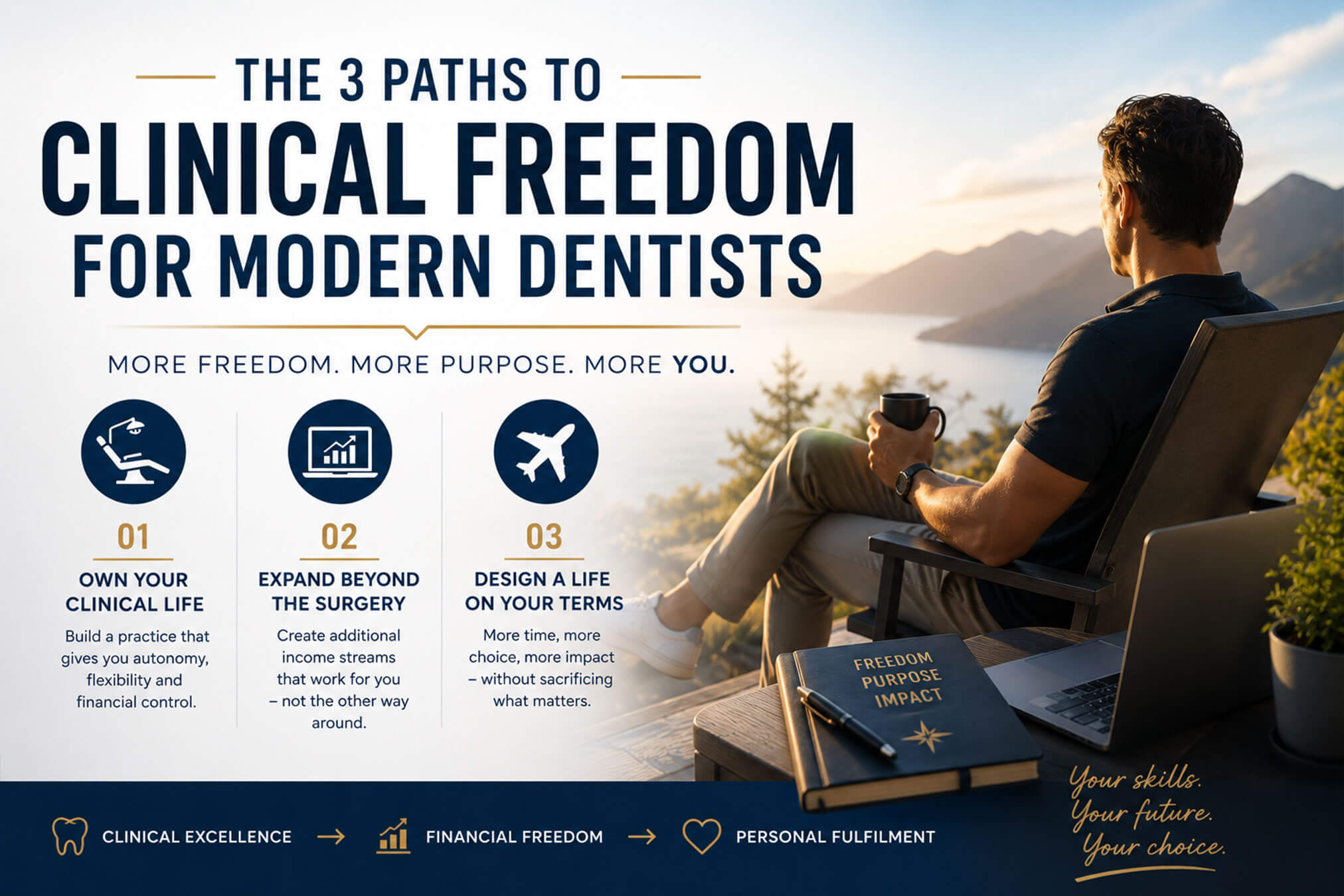
This article is about changing that. Not with motivational clichés. Not with vague exhortations to “diversify” or “think differently.” With three specific, structured, proven pathways that together constitute what we might call the architecture of Clinical Freedom — and which represent the core of everything built across the Botulinum Toxin Club, the Dental Property Club, and Performance Reset.
What Clinical Freedom Actually Means
Before we examine the three paths, we need to be precise about the destination.
Freedom, in the context of a dental career, is not a holiday. It is not early retirement. It is not even the removal of work from your life. Most dentists who say they want freedom do not, when pressed, actually want to stop working. They want to stop having to work. They want to stop operating from a position of financial dependency, physical depletion, and professional constriction.
Clinical Freedom, properly defined, is the intersection of three conditions:
Controlled Capacity — the ability to manage how much you give, not just how much you earn, so that your output is a deliberate choice rather than a compulsion.
Optional Income — income streams that do not require your physical presence in a surgery for a fixed number of hours per week, which means income that funds your life even when you are not chairside.
Intelligent Leverage — the ability to translate your existing clinical skills, your professional credibility, your anatomical knowledge, and your patient relationships into commercial assets that work independently of the NHS contract, the UDA threshold, or the goodwill of a practice principal.
These three conditions do not arrive simultaneously or spontaneously. They are built, deliberately and systematically, across three distinct paths. And the sequence in which you pursue them matters.
Path One: Clinical Expansion — Facial Aesthetics as the First Door to Freedom
Why Dentists Are Built for This
There is a reason the most dangerous myth in facial aesthetics is that it belongs to dermatologists and plastic surgeons. It does not. Dentists — properly trained, properly supported — are among the most naturally positioned clinicians in the world to deliver outstanding aesthetic outcomes.
Consider what a dentist already possesses by the time they complete their BDS: a comprehensive, three-dimensional understanding of facial anatomy that most aesthetic practitioners spend years trying to acquire. An innate appreciation for facial proportions, for the relationship between the dental arch and the perioral region, for the way movement, muscle tension, and structural asymmetry interact. A trained hand. An eye for symmetry calibrated by years of restorative and cosmetic dentistry. A patient base already predisposed to trust clinical interventions on their face.
Dentistry, in this sense, is the pre-loaded foundation for aesthetic medicine. The training is the unlock. Not a reinvention of yourself — a revelation of capacity that was already there.
The Botulinum Toxin Club was built around exactly this insight. With over 24 years of experience in facial aesthetics, more than 15,000 cases treated, and 3,000+ delegates trained, the BTC framework is not simply a skills course. It is a structured, confidence-first pathway from clinical competence to commercial mastery — what we call the Launchpad Programme™.
From Red Zone to Green Zone
Every clinician begins in what we call the Red Zone: hesitant, uncertain, dependent on protocols they do not yet fully understand. This is the zone where injecting feels mechanical, where every consultation carries the low hum of clinical anxiety, where the gap between knowing and doing still feels dangerously wide.
The BTC methodology is designed to move delegates systematically from the Red Zone to what we call the Green Zone — a state of confident, competent, commercially calm practice. The distinction matters, because patients can feel the difference. A confident clinician communicates certainty through posture, through language, through the quality of their consultation. That certainty is, in many respects, the treatment. It is what converts a single appointment into a relationship, and a relationship into a referral.
Clinical mastery in this context is not just a technical skill. It is a state — the alignment of knowledge, confidence, and communication that transforms a competent technician into a trusted expert.
The Commercial Architecture
The most under-discussed dimension of aesthetic medicine for dentists is not the technique. It is the business model. Aesthetic treatments, when structured correctly, do not behave like NHS dentistry. They do not erode under the weight of UDA targets. They are not subject to the same regulatory corrosion or the same patient volume pressure. They create repeating revenue cycles — maintenance appointments, treatment plans, loyalty — that NHS dentistry structurally cannot.
The Singh’s Success System® built into the BTC curriculum is designed to unlock £5,000 in additional income within 90 days of completing training — without requiring expensive marketing campaigns or exhausting social media strategies. The mechanism is not magic; it is method. Positioning, packaging, patient communication, and pricing architecture — the commercial infrastructure that most aesthetic training providers simply do not teach.
The UK cosmetic dentistry and aesthetics market is now worth over £3 billion annually. That figure is not a background statistic. It is a measure of the demand already circulating in the market — demand from patients who walk past dental practices every day, who are already spending on aesthetic outcomes, and who would overwhelmingly prefer to receive those treatments from a clinician they already trust.
Facial aesthetics is not a side hustle. Done properly, it is the first structural component of a financially independent clinical career.
Path Two: Financial Architecture — Property Investment as the Engine of Passive Income
Trading Time for Money Is a Trap
Here is the fundamental structural problem with dentistry as a wealth-building vehicle.
Your income, in its default configuration, is entirely dependent on your presence. The moment you stop working — through illness, injury, burnout, or choice — the income stops. You are, in economic terms, a single-point-of-failure system. And single-point-of-failure systems are not robust. They are brittle.
This is not unique to dentistry. It is the central limitation of all professional services income — what economists call active income. And it is the reason why some of the highest-earning professionals in the world still find themselves, in their fifties, financially pressured, unable to retire, and deeply anxious about what happens if they cannot work.
The solution to this structural vulnerability is not to earn more from dentistry. It is to build income streams that are structurally independent of your physical presence. Income streams that produce returns while you sleep, while you treat patients, while you take the holiday you have been postponing for three years.
Property investment is the most direct, most accessible, and — for dental professionals — the most strategically aligned vehicle for building that income.
Why Property, and Why Now
The Dental Property Club was established in 2012 with a simple, structural argument: dental professionals are among the most creditworthy borrowers in the country, they typically have higher-than-average incomes, professional stability, and the kind of risk profile that makes them ideal candidates for leveraged property investment.
The transformation the DPC describes — from working for money to money working for you; from trading time for income to choosing when you work — is not aspirational language. It is the description of a specific financial architecture, built systematically, over time, through the strategic acquisition and management of residential and commercial property.
Dr Harry Singh has been investing in property since 1998 — speaking, as he puts it, “from the trenches and not an ivory tower”. That phrase matters. There is an entire industry of property gurus who teach from theory, from spreadsheets, from seminars designed primarily to sell more seminars. The DPC framework is built from lived practice: from acquisitions actually made, from deals actually structured, from portfolios actually managed across market cycles, interest rate fluctuations, and once-in-a-generation events like a global pandemic.
The Diversification Imperative
The events of 2020 were a clarifying moment for many dental professionals. Practices closed. UDA targets were suspended. Active income — the only income most dentists had — simply stopped. For those with property portfolios already in place, the disruption was uncomfortable but survivable. For those without, it was financially devastating.
The lesson was not that dentistry is unreliable. The lesson was that single-source income is architecturally fragile, and that the time to build a second income stream is not when you need it — it is before you need it.
Passive income from property does not require a dentist to abandon clinical practice. It requires, instead, the cultivation of a parallel financial structure — one that develops incrementally, compounds over time, and eventually reaches the point where it funds the lifestyle that dentistry currently must sustain alone.
That is the inflection point. The moment when dentistry becomes a choice rather than a necessity. The moment when Clinical Freedom stops being a concept and becomes a lived condition.
The DPC provides both training and joint venture options — meaning that dentists at every stage of financial readiness and property knowledge can access the framework, whether they are building from scratch or accelerating an existing portfolio.
The Mindset Prerequisite
One of the most commonly underestimated barriers to property investment for dental professionals is not financial. It is psychological. The same conditioning that makes a good clinician — caution, precision, risk-aversion, the professional instinct to avoid harm — can also make wealth-building intimidating.
Dentists are trained to see risk as something to be minimised, not managed. Property investment requires the ability to distinguish between risk that is unacceptable and risk that is merely unfamiliar. That distinction is a mindset shift, and it is one that the DPC curriculum addresses as a foundational component, not an afterthought.
As one DPC delegate noted: “DPC has shown me not only is it possible for those who may currently be in a cash poor situation but that we are our own obstacle in achieving our own financial goals.”
The obstacle is not the market. It is rarely the capital. Most often, it is the internally constructed belief that wealth-building at this level is for someone else — someone richer, someone bolder, someone with fewer clinical commitments. That belief is, in almost every case, incorrect.
Path Three: Performance Architecture — The Reset That Makes Everything Else Sustainable
The Hidden Cost of High Output
There is a particular kind of exhaustion that does not show up on any clinical assessment. It is not burnout in the popular sense — the sudden collapse, the crisis, the dramatic exit from the profession. It is quieter than that. More gradual. More insidious.
It shows up as the Sunday evening dread that begins arriving earlier each week. The slight reduction in patience with patients who ask the same question twice. The flat feeling at the end of a technically excellent day. The persistent sense that you are running — not forward, but on a treadmill. High output. Low recovery. The performance stable, but the person behind it slowly compressing.
Dentistry, as a physical and psychological environment, is inherently high-demand. The musculoskeletal load — the neck, the back, the hips, the wrists — accumulates over years of static posture and precision work. The cognitive load — the constant risk management, the regulatory vigilance, the patient relationship maintenance — does not switch off at the end of a session. And the emotional cost of a complaint, a GDC referral, or even a particularly difficult patient interaction carries a residual weight that is rarely fully processed.
The result, over time, is what Performance Reset describes as structural erosion: not a single breaking point, but a progressive narrowing of capacity, resilience, and cognitive range. Output remains. The performance, to the outside world, looks fine. But internally, the reserves are being drawn down. And the longer this continues without recalibration, the more the performance becomes reactive — driven by habit and compulsion rather than intention and choice.
More than half of UK dental professionals have already continued working with deteriorating mental health. The 2024 Dentistry Census found that 52% sought support for mental health issues. These numbers are not outliers. They are the statistical expression of a structural problem that affects even the highest performers in the profession.
What Recalibration Actually Is
Performance Reset — with Dr Harry Singh — is not a wellness programme. It is not a mindfulness app or a vague commitment to better work-life balance. It is a private, structured, time-bound intervention designed to restore three specific domains of performance:
Domain 1: Nervous System Stabilisation. The capacity to remain calm, deliberate, and non-reactive — not just in a clinical setting, but across the full architecture of a professional and personal life. For many high-performing dentists, the nervous system is chronically over-activated: wired for threat, conditioned for urgency, unable to distinguish between genuine emergency and the quotidian pressure of a busy appointment book.
Domain 2: Physical Restoration. The specific, cumulative physical damage of a dental career is well-documented but rarely systematically addressed. Neck. Back. Hips. Wrists. These are not separate issues — they are an interconnected physical architecture that, when compromised, affects not just comfort but cognitive performance, emotional regulation, and long-term clinical sustainability.
Domain 3: Cognitive Clarity and Focus. The ability to lead the day rather than react to it. To think expansively rather than from a position of compressed urgency. To make strategic decisions — about the practice, about the portfolio, about the career — from a position of clarity rather than exhaustion.
The structure is precise: a 60-minute Recalibration Consultation that produces a written Personal Performance Reset Map, followed by an 8-to-12-week private intervention with disciplined protocols and light accountability. Places are deliberately limited — six to eight dentists per intake — not as a marketing mechanism, but as a genuine quality control. This is not a group programme. It is a precision intervention, and precision requires selective application.
Why Performance Is a Strategic Asset
The framing of performance management as an indulgence — as something you earn the right to prioritise after you have dealt with everything else — is one of the most expensive misconceptions in professional life.
Your performance is your most valuable professional asset. More valuable than your equipment, your practice premises, your patient list. Because all of those things depend, ultimately, on the quality of judgment, presence, and capacity that you bring to them. Erode the asset, and everything downstream of it erodes too.
The Performance Reset philosophy is built on this insight: that recalibration is not indulgence. It is responsibility. A dentist who operates at compressed capacity makes different decisions than one who operates at full capacity. Takes different risks. Misses different signals. Tolerates different mediocrity. And gradually, the gap between the practice you are running and the practice you could be running widens — not because of external obstacles, but because the internal instrument that navigates those obstacles has never been properly maintained.
This is why the Performance Reset sits not merely alongside the aesthetic and property pathways, but beneath them. It is the foundation on which sustainable elevation is built. A dentist who adds facial aesthetics revenue without addressing the depletion that drove them to seek it will eventually find that the new income stream becomes just another source of pressure. A dentist who builds a property portfolio from a position of chronic cognitive compression will make worse investment decisions than their analytical capacity, properly restored, would allow.
The three paths to Clinical Freedom are interdependent. Not sequential alternatives, but interlocking systems. The reset enables the expansion. The expansion funds the investment. The investment removes the compulsion. And without the compulsion, the reset becomes permanent.
The Architecture of Elevation
There is a philosophy that runs through all three of these pathways — one that is worth making explicit, because it is the connective tissue that makes them coherent rather than simply coincidental.
That philosophy might be summarised as this: elevation without sustainability is unsustainable.
It is possible to elevate your clinical income through facial aesthetics without addressing your performance foundations — but only temporarily. It is possible to build a property portfolio as a form of financial escapism — acquiring assets to compensate for a professional life that feels out of control — but the freedom such a portfolio offers will remain theoretical until the person managing it operates at full capacity. And it is possible to reset your performance in isolation, to recalibrate your nervous system and restore your physical resilience, without ever building the financial or clinical architecture that gives that restored capacity somewhere meaningful to go.
The Three Pillars of Elevation — what the broader framework calls Clinical, Commercial, and Personal elevation — are not separate products. They are not three courses from three unrelated providers. They are a single architectural system, designed to be built together, sequenced intelligently, and maintained as a permanent operating structure rather than a temporary intervention.
The Clinician Freedom Scorecard — the diagnostic tool at the centre of drharrysingh.com — identifies which of the three constraints is most limiting for any individual dentist at any given point. Not as a sales tool. As a genuine diagnostic instrument. Because the starting point matters. A dentist who is primarily constrained by performance depletion needs a different first step than one who is primarily constrained by financial architecture, or one whose clinical expansion has stalled for lack of commercial confidence.
Freedom, properly understood, is not a uniform destination. It is a customised architecture — built from the specific constraints and specific assets of the specific professional who is building it.
The Honest Conversation
The dental profession is experiencing an extraordinary paradox. By every external measure, dentistry remains a prestigious, well-compensated, respected profession. By almost every internal measure — mental health, burnout prevalence, professional satisfaction, sense of autonomy — it is experiencing a quiet crisis of unprecedented scale.
Some 57% of dental professionals in one major survey reported that their mental wellbeing was worse in the aftermath of the pandemic than during it. More than half were considering their future in the profession entirely. Dentists experiencing the highest NHS commitment — those most deeply embedded in the traditional model — were experiencing the highest levels of emotional exhaustion.
This is not a failing on the part of individual dentists. It is the predictable output of a system that was not designed for sustainability — that was designed for extraction, not elevation.
The three paths described in this article are not a rejection of dentistry. They are a reclamation of the agency, autonomy, and ambition that many dentists brought into the profession and subsequently had compressed out of them.
Facial aesthetics training — through the Botulinum Toxin Club — gives you a new clinical dimension, a new income architecture, and a renewed sense of professional purpose.
Property investment — through the Dental Property Club — gives you financial independence that is structurally decoupled from the surgery chair, and the freedom that comes with genuinely optional work.
Performance Reset — with Dr Harry Singh — gives you the restored capacity to pursue both with the clarity, energy, and cognitive range they deserve.
Together, they constitute something the dental school never offered, and the profession rarely models: a complete, sustainable, intelligent pathway to Clinical Freedom.
The First Step Is a Diagnostic, Not a Decision
One of the most common conversations in the BTC, DPC, and Performance Reset communities involves dentists who spent months — sometimes years — aware that something needed to change, but uncertain where to begin. The uncertainty itself became a reason for inaction. And the inaction compounded the very conditions — financial pressure, physical depletion, clinical constriction — that made change necessary in the first place.
The Clinician Freedom Scorecard exists to interrupt that cycle. It takes fewer than four minutes to complete. It identifies, with precision, which of the three primary constraints — clinical, financial, or performance — is currently most limiting your capacity for freedom. And it tells you, without ambiguity, where the most valuable first investment of your energy and attention should be.
Freedom is not complex. It is built from simple, sequential, deliberate steps — each one clearing the way for the next. The only move that does not work is no move at all.
The three paths are open. The architecture is proven. The question — the one that has been forming quietly for months or years — has an answer.
The answer is: start here.
References
- Dental professionals feel they have no choice but to work when their mental health is suffering - Learn to reduce your risk with our online articles, features, case reports, guidance and resources.
- UDA pressures? Prevent burnout in dentistry before it strikes - Aditi Bhalla asks why we wait for burnout to hit before addressing it, and highlights the importance...
- Protecting the Wellbeing of Dentists in Private Practice - According to the 2024 'Dentistry Census' 52% of dental professionals surveyed had sought support for...
- Dentistry is Shifting From Functional To Aesthetic and Wellbeing - Another reason dentists are adding beauty treatments is the financial opportunity. Cosmetic treatmen...
- Property investment – the ideal passive income stream in 2021 - One of the great realisations for dentists in 2020 was that their income is not as rock solid as the...
- How stress and burnout impact dental teams - General Dental Council - Workplace difficulties deeply affect our overall mental health, making it crucial for dental teams t...
- NHS England » Submission to the Review Body on Doctors' and ... - Overall, the NHS is providing more care contacts in 2024 across secondary care services, mental heal...
- Over half of dental professionals say mental wellbeing is ... - More than half of dental professionals in the UK (57%) who took part in a survey say their mental he...
- World Mental Health Day: is the profession still suffering? - Dentistry - We take a closer look at data from the Dentistry Census 2024 on the topic of mental health for World...
- Burnout and depression in the UK dental workforce - PMC - NIH - Participants with an NHS commitment between 75-99% were experiencing significantly higher levels of ...